

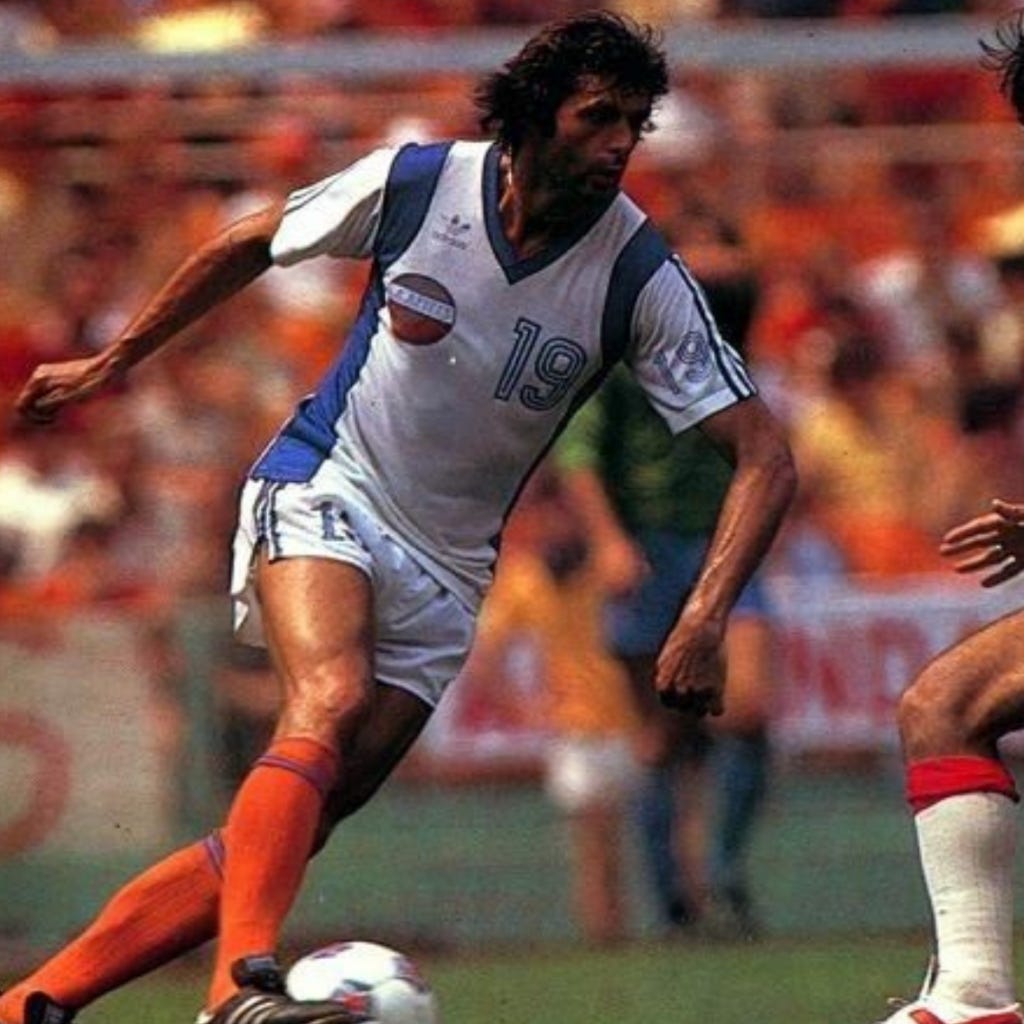
Some footballers belong to a club because they played there.
Others become part of its identity.
Wim Suurbier is part of the Los Angeles Aztecs identity.
Before overlapping full-backs became normal, before coaches talked endlessly about positional play, transitions and creating overloads, Suurbier was already doing it.
He was one of the men who helped invent modern football.
And in 1979, he brought it to Los Angeles.
From Ajax to the Aztecs
Suurbier was a cornerstone of perhaps the most influential club side football had seen.
He made 509 appearances for Ajax, winning three consecutive European Cups in 1971, 1972 and 1973. He also won 60 caps for the Netherlands and appeared in the World Cup finals of both 1974 and 1978.
But trophies only explain part of him.
Suurbier was a right-back at a time when right-backs were generally expected to defend their side of the pitch and behave themselves.
He had other ideas.
He attacked. He overlapped. He carried the ball forward. He created width and then had the speed and stamina to recover.
Ajax later described him as the Netherlands’ first modern full-back.
Watch football today and you see his descendants everywhere.
The Dutch Revolution Arrives in LA
Then came Los Angeles.
In 1979 the Aztecs assembled something extraordinary.
Rinus Michels was the coach. Johan Cruyff was wearing No.14. Wim Suurbier was wearing No.19.
This was not America simply importing famous names for a farewell tour.
These were some of the people who had fundamentally changed how football was played.
Michels coached the 1979 Aztecs to an 18-12 NASL record, while contemporary photographs show Suurbier alongside Cruyff in the Aztecs side.
That matters when we talk about the history of this club.
The Los Angeles Aztecs were connected directly to one of football’s great revolutions.
Not through a marketing campaign.
Through the people who created it.
Number 19
Suurbier played for the Aztecs across the 1979, 1980 and 1981 NASL seasons, making 73 outdoor league appearances in Los Angeles.
Look at the old photographs and there he is.
The hair. The unmistakable stride. Number 19.
Sometimes beside Cruyff.
Sometimes charging down the right flank.
Sometimes doing the less glamorous work that allowed everybody else to play.
Cruyff naturally attracted the attention.
Great football teams, though, are never built from one genius.
They are built from relationships.
One player moves.
Another understands why.
One creates space.
Another fills it.
That was Total Football.
And Suurbier understood it instinctively.
More Than a Name From the Past
Football history has a habit of reducing players to statistics.
European Cups.
International caps.
World Cup finals.
Appearances.
Suurbier deserves every one of those numbers.
But his greater legacy is visible every weekend without his name being mentioned.
The attacking full-back.
The defender comfortable high up the pitch.
The expectation that a defender should understand space rather than simply mark an opponent.
The idea that when your team has the ball, everybody attacks, and when your team loses it, everybody reacts.
That football did not appear from nowhere.
Suurbier helped build it.
An Aztec Forever
Wim Suurbier died in 2020 at the age of 75. UEFA remembered a three-time European champion and two-time World Cup finalist. Ajax remembered one of the pioneers of Total Football.
We remember something else as well.
He was one of us.
For three seasons, one of the architects of modern football wore the Los Angeles Aztecs shirt.
That should never become a forgotten paragraph in NASL history.
As the Aztecs look towards the future, we also have a responsibility to protect the people who built the club’s past.
George Best.
Johan Cruyff.
Rinus Michels.
And Wim Suurbier.
Different personalities. Different roles.
All part of the same extraordinary story.
Wim Suurbier
1945–2020
Ajax legend. Dutch international. Pioneer of Total Football. Los Angeles Aztec.
Forever part of our club.