

Sometimes history doesn’t need rewriting.
It needs reading properly.
Golden State recently published an important piece by José M. Alamillo and José Luis Collazo Jr.:
“Remember the L.A. Aztecs? Exactly. Will the World Cup finally give Latinos their due?”
It tells a bigger story than the rise and fall of one soccer club.
It tells the story of American soccer repeatedly searching for an audience while failing to fully embrace many of the people who already loved the game.
The Los Angeles Aztecs were part of that story.
Read the original Golden State article here.
The Aztecs Started in East LA
When the club launched in 1974, this wasn’t accidental.
The Aztecs name was chosen to connect with Southern California’s Mexican community.
The first game was played at East Los Angeles College Stadium.
There was mariachi.
Ballet Folklórico.
A Día de los Niños celebration.
Free shirts for children.
And there was a football team built from everywhere.
Argentina. Brazil. Trinidad. Uruguay. Mexico. America.
Local Mexican-American players were part of it too.
The Aztecs weren’t trying to manufacture soccer culture.
They had walked straight into a community where it already existed.
Then they won the NASL Championship in their first season.
Not a bad start.
Then Football Made a Familiar Mistake
The club changed ownership.
It moved from East Los Angeles to Torrance.
The philosophy changed too.
Golden State documents something extraordinary.
The 1974 Aztecs had 15 Latin American players.
By 1977, there were none.
Think about that.
A club created partly around Southern California’s Latino soccer community gradually moved away from the identity that had helped make it distinctive.
American soccer has made versions of this mistake ever since.
Find an authentic football culture.
Professionalise it.
Package it.
Move it.
Then wonder where everybody went.
The People Were Never the Problem
This matters because the same conversation continues today.
The market did not suddenly arrive.
It was always here.
On fields.
In parks.
At schools.
In Sunday leagues.
In Mexican-American families.
Across immigrant communities.
Across generations.
Across Los Angeles.
You don’t need to teach these communities to love fútbol.
They already do.
Professional soccer needs to become better at respecting the people who kept playing it when nobody in a boardroom was watching.
That means more than marketing.
It means changing the model.
Talent Should Be Found by Ability, Not Household Income
One of the clearest places to start is player development.
America has produced enormous participation in youth soccer, but too much of the pathway has historically depended on whether a family can afford to remain inside it.
That cannot be the foundation of the new Los Angeles Aztecs.
Our objective is simple:
If a player is good enough, money should not be the reason we never find them.
The club’s long-term football pathway is therefore being designed around open identification, community scouting and removing financial barriers for talented local players.
We want to look where others don’t.
Sunday leagues.
High schools.
Independent academies.
Community clubs.
Street football.
Open trials.
The enormous Hispanic football ecosystem across Southern California.
Not every good player comes through an expensive academy.
Sometimes the best player is the kid nobody has properly looked at yet.
Los Angeles has millions of people and one of the deepest football cultures in America.
Our job isn’t to import an identity.
It’s to uncover the talent already here.
Where We Build Matters
The lesson of East LA and Torrance cannot simply become an interesting paragraph in a history book.
It has to influence the decisions we make now.
That includes where the club eventually puts down roots.
As part of the wider development process, locations including Wilmington and the Harbor area, Pacoima and Palmdale have been evaluated.
These aren’t dots on a developer’s map.
The question is bigger:
Where does football already live?
Where are children playing?
Where are families watching Liga MX, the Premier League, MLS and the World Cup?
Where are the Sunday leagues?
Where can a stadium become part of an existing community rather than an object dropped into one?
The original Aztecs began by understanding that geography and identity are connected.
We should not forget it again.
A Stadium Cannot Be an Island
That philosophy also changes the economics.
We are not thinking only about building a stadium that opens twenty or thirty times a year.
The wider vision is an LA Aztecs entertainment district built around football but alive beyond matchday.
That could mean 20 to 35 acres or more, depending on the final site and development structure.
Football sits at the centre.
But around it can come food, independent retail, community events, youth tournaments, entertainment, public space and complementary development.
And the businesses around the stadium should not all arrive from a corporate leasing catalogue.
Los Angeles already has the food.
The entrepreneurs.
The retailers.
The culture.
The district should give some of them a front door.
That isn’t charity.
It’s good development.
A place people identify with is more likely to be used.
A place people use generates activity.
Activity creates footfall.
Footfall supports tenants.
Tenants create non-matchday revenue.
And non-matchday revenue helps make the entire project more resilient.
Culture and commercial performance are not opposites.
Done properly, one strengthens the other.
Don’t Build a Wall Around Football
People shouldn’t be treated as a demographic when somebody wants to sell them a ticket.
They should be part of the club’s financial and operational DNA.
That is why site selection matters.
It is why the football pathway must reduce the barriers created by pay-to-play.
It is why the surrounding district should create opportunities for local businesses and vendors.
And it is why community benefit cannot end with a ribbon-cutting photograph.
As development discussions advance, our intention is to put measurable community commitments into the project structure.
That means areas such as local procurement, fair employment standards, youth access, community use of facilities and opportunities for local independent businesses should become defined commitments rather than vague promises.
Where appropriate, those commitments should ultimately be captured through formal civic and development agreements.
Because if we tell people:
“This is your club.”
Then eventually the paperwork should say so too.
This Is Bigger Than Marketing
There is a lazy way to approach the Hispanic soccer market.
Translate some advertising.
Hire an influencer.
Run a heritage night.
Sell a shirt.
Call it community engagement.
That isn’t what interests us.
Los Angeles doesn’t need another organisation discovering Latino soccer every four years when the World Cup arrives.
The culture is permanent.
The relationship should be permanent too.
Football doesn’t become more American by removing its immigrant roots.
Those immigrant roots are American soccer.
Los Angeles might be the clearest example of all.
So What Should the New LA Aztecs Be?
Not a museum.
Not a nostalgia project.
And certainly not an attempt to recreate 1974.
George Best matters.
Johan Cruyff matters.
The NASL Championship matters.
But heritage only has value if you use it to build something relevant now.
We want local players.
Open doors.
Affordable pathways.
Front-foot football.
Entertainment.
Community ownership.
Local businesses.
A permanent home.
A district that works seven days a week rather than only when the referee blows the whistle.
And ultimately a football club that belongs naturally inside Los Angeles rather than simply carrying its name.
We Can’t Change What Happened
The original Aztecs eventually disappeared.
We can’t rewrite that.
But we can learn from it.
The first LA Aztecs understood something important.
Go where football already lives.
Bring people together.
Put on a show.
Give the city something to belong to.
Somewhere along the journey, that connection weakened.
So the challenge facing the new Los Angeles Aztecs isn’t complicated.
Find the people.
Find the players.
Build where football lives.
Let the community participate in the economics.
Then put those principles into the structure of the club.
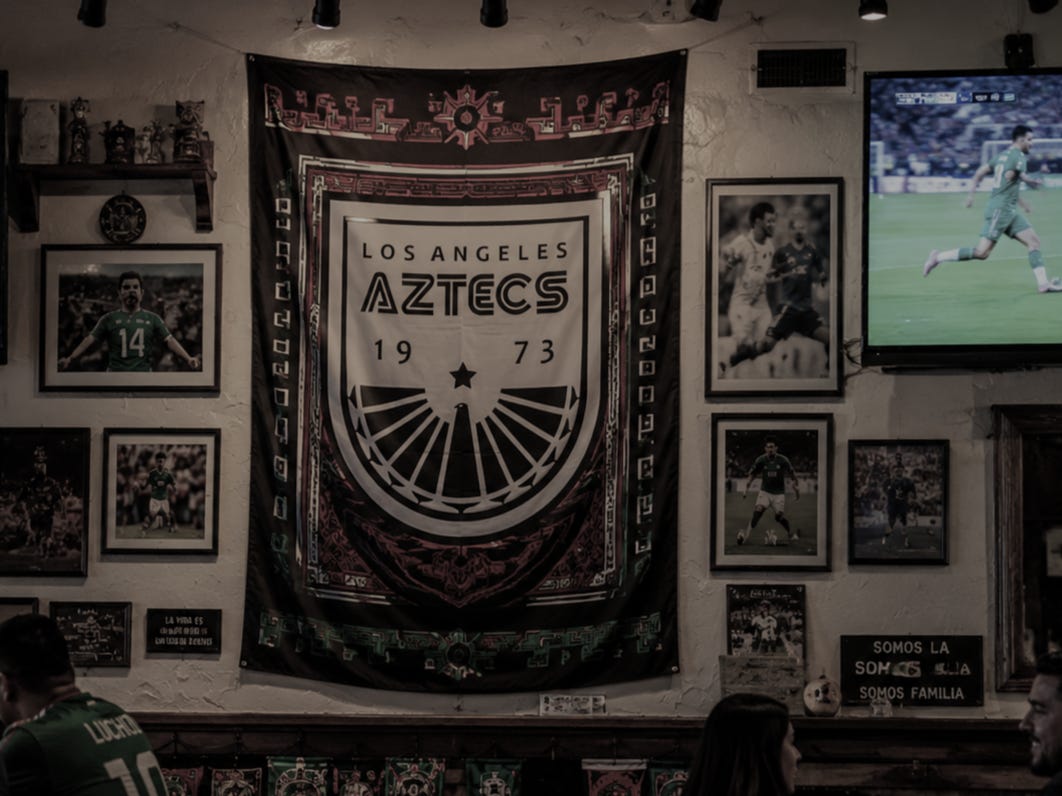
The badge survived.
The history survived.
The football culture survived.
And the market?
The market was always here.
Further reading: José M. Alamillo and José Luis Collazo Jr., “Remember the L.A. Aztecs? Exactly. Will the World Cup finally give Latinos their due?” — Golden State / Zócalo Public Square.