

Football is full of advisers.
Some know football.
Some know property.
Some are mainly good at appearing in photographs beside both.
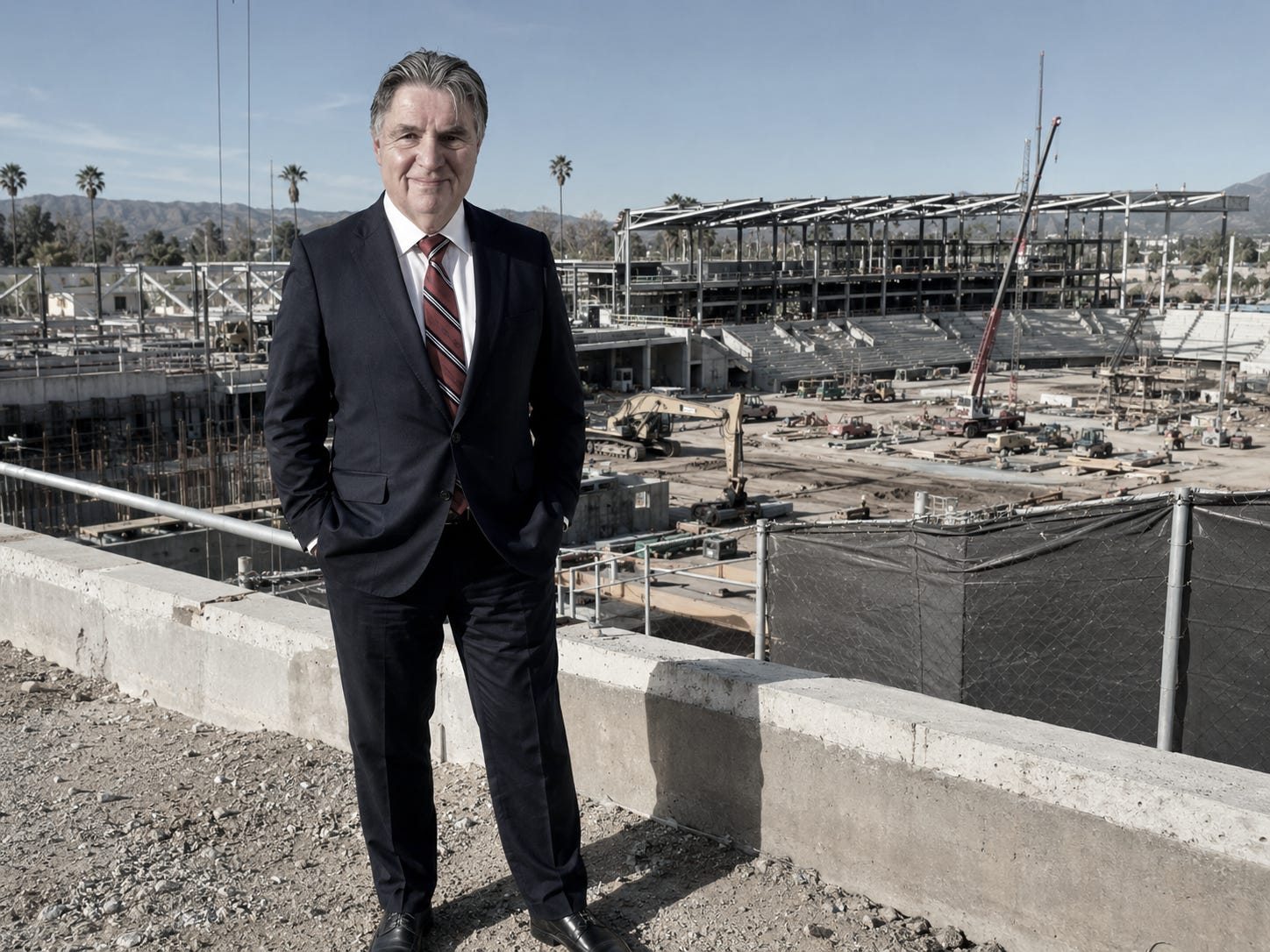
Mick Pattinson is different.
Mick is joining the Los Angeles Aztecs as an adviser.
He is also a friend.
More importantly, he understands two things we increasingly need to understand at the same time.
Football clubs.
And how California gets built.
Because the question facing the Los Angeles Aztecs is changing.
It is no longer simply:
Can this club return?
It is becoming:
Where does it belong?
He Knows Football When Football Gets Difficult
Mick is a former Luton Town shareholder and associate director and was involved with the LTFC2020 group during one of the hardest periods in the club’s history.
Administration.
Financial uncertainty.
Supporters wondering what would be left.
That is rather different from discovering football ownership through a hospitality box and a PowerPoint presentation.
Difficult periods teach you what a football club actually is.
Not simply a balance sheet.
History.
Identity.
Supporters.
Responsibility.
That philosophy sits naturally with what we are trying to build with the Aztecs.
A serious football club without forgetting who football is supposed to belong to.
Then There Is California
This is where Mick becomes particularly useful.
His career stretches deep into the California building industry.
He led Barratt’s American operation and served as President of the California Building Industry Association, having also held senior leadership roles within the San Diego building industry.
During that era, Barratt’s California operations developed tens of thousands of homes across Southern California.
San Diego.
Orange County.
Riverside.
Land.
Planning.
Finance.
Infrastructure.
Local government.
Construction.
Development economics.
Mick has spent decades around the things that need to happen before anybody gets to cut a ribbon.
That matters considerably more to us now than another football celebrity saying they like the badge.
The Conversation Has Already Changed
We have also begun an early-stage dialogue with the Los Angeles City Planning Department as we explore what a permanent home for the Aztecs could require.
And the questions coming back are exactly the right ones.
Where in Los Angeles?
How much land?
Should the site be accessible by transit?
Could residential development form part of it?
What is the overall scale?
A senior planning official has already asked us to begin narrowing those questions and provided citywide planning information to help inform that process.
That is not an endorsement.
It is not a stadium agreement.
And it would be ridiculous to pretend otherwise.
But it is a real conversation.
And real conversations are where projects begin.
Around 20 Acres
Our current working ambition is approximately 20 acres.
Not because twenty is a magic number.
Because we are not thinking about a football pitch surrounded by parking spaces.
We are exploring something broader.
A right-sized football stadium.
Academy, training and community football facilities.
Housing.
Food.
Entertainment.
Public space.
Commercial uses capable of helping support the wider project.
A place with a reason to exist on Wednesday afternoon as well as Saturday night.
That changes everything.
Suddenly the conversation is not merely about football.
It is about placemaking.
Target Corridors. Community Anchor.
A roughly 20-acre master plan means being disciplined about what qualifies as a serious site.
We are particularly interested in locations that can connect properly with the wider Los Angeles transport network, including opportunities with strong existing or future transit access.
But access is only half the equation.
A permanent Aztecs home should also help build the next generation of the club.
That means exploring space for academy and community football facilities, creating somewhere young players from across Los Angeles can train, develop and belong.
The first team might play there twenty nights a year.
The community should be able to use it all year.
That is the difference between building a stadium and building a football club.
The Immediate Brief
That is where Mick comes in.
His role is not ceremonial.
It is practical.
Site
Help us challenge potential locations across Greater Los Angeles.
Is there enough land?
Can people actually reach it?
What surrounds it?
Could it support a wider district rather than an isolated stadium?
Development
Look beyond the lovely render.
What can actually be built?
What infrastructure is required?
Where are the obvious problems?
What needs to sit around the stadium to make the economics stronger?
Reality
Perhaps most importantly:
Tell us when something does not work.
That may be the most valuable advice of all.
There will be sites that look perfect from fifty feet in the air and make absolutely no sense once somebody examines the ground beneath them.
Good.
Bin them.
The objective is not to announce a location quickly.
The objective is to find the right location.
Why Now?
Because the Aztecs project is entering a different phase.
A football revival can begin with history.
A football club cannot survive on history.
Eventually you need somewhere to play.
Then somewhere to train.
Then somewhere supporters can call home.
And once you start discussing land, housing, transit, planning and infrastructure with a city, the people sitting around your table need to change.
You need football experience.
You need development experience.
You need people willing to tell you what will work.
And what won’t.
Mick brings all three.
Advice, Not Applause
Mick being a friend does not mean I want him agreeing with everything.
Quite the opposite.
I have no interest in surrounding this project with people whose principal skill is nodding.
That is not an advisory board.
It is an audience.
Mick asks questions.
Why here?
Why this size?
Who pays?
What does the city receive?
What does the supporter receive?
What happens if construction costs move?
What happens in ten years?
Good.
A football dream becomes a football project when somebody starts putting awkward numbers beside the beautiful pictures.
Foundations
There is something fitting about Mick becoming involved at this stage.
He knows football when football gets difficult.
He knows California when building gets difficult.
And we are now trying to answer perhaps the biggest question facing the modern Los Angeles Aztecs.
Where do we build home?
We will look.
We will listen.
We will speak with cities.
We will test land.
We will challenge the economics.
Some ideas will survive.
Others will deserve putting in the bin.
That is not failure.
That is how serious projects get built.
Because every football club needs foundations.
Some are cultural.
Some are financial.
Eventually, some need pouring into concrete.
Welcome aboard, Mick.
Now we build.
Football ahead.