

Football has become very good at producing content.
It has become less reliable at producing joy.
A match can now arrive surrounded by betting partners, launch films, hospitality packages and men wearing lanyards who describe supporters as consumers.
Then the whistle blows.
Two teams pass sideways for 20 minutes.
Everybody protects their market value.
Nobody tries anything that might make a child fall in love with the game.
We want something different for the Los Angeles Aztecs.
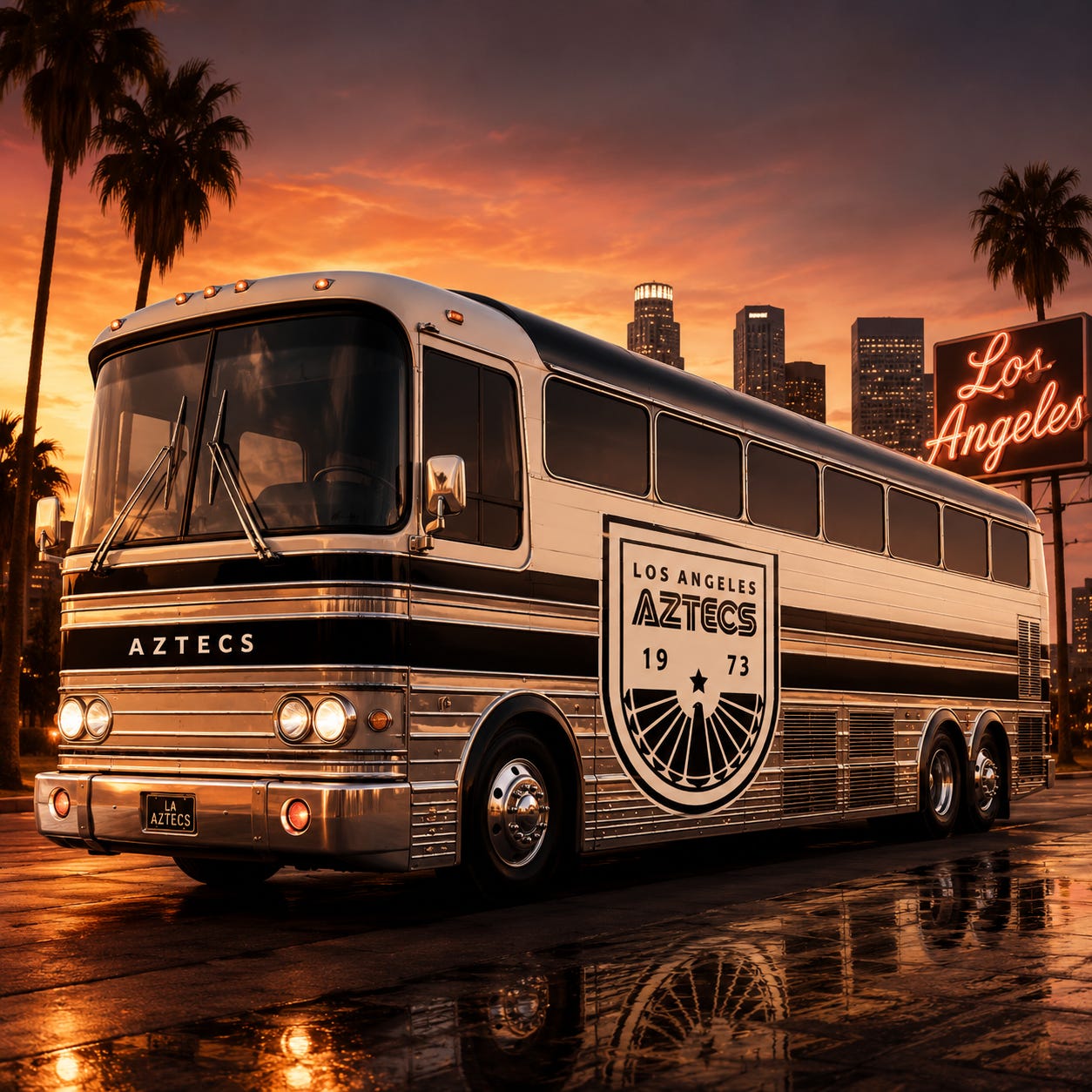
We want to take football back on the road.
Not as a circus pretending to be a football match.
Not as a veterans’ kickabout conducted at walking pace.
Not as a corporate exhibition where the result was decided in a hotel conference room.
Real players.
Real competition.
Real skill.
But presented as a complete night of sports entertainment.
The Los Angeles Aztecs can become football’s great touring team.
The Globetrotters understood something football forgot
The Harlem Globetrotters have spent generations taking basketball directly to audiences.
Their model combined elite ball-handling, athleticism, humour, theatre and a clear identity people could recognise before the team even entered the arena. The organisation continues to tour internationally and describes itself as a mixture of family entertainment, basketball skill and spectacle.
They did not wait for every town to build a permanent franchise.
They arrived.
They performed.
They entertained.
Then they moved to the next city.
The badge travelled.
The players became characters.
The show became bigger than any single venue.
That is not a small achievement.
It is a sporting institution built on portability.
Football should have learned from it years ago.
The Savannah Bananas made the game feel alive
The Savannah Bananas attacked a different problem.
Baseball had become slow, formal and increasingly disconnected from younger audiences.
The Bananas did not respond with another marketing campaign explaining why people ought to care.
They changed the experience.
Banana Ball is presented as a faster, entertainment-led version of baseball. Its games feature player performances, music, choreography and direct audience involvement, all built around the organisation’s promise to put fans first.
Purists initially laughed.
Then audiences arrived.
There is a lesson in that.
People do not dislike tradition.
They dislike boredom wearing tradition’s coat.
The Bananas understood that sport is not damaged when supporters enjoy themselves.
Quite the opposite.
We are not copying either of them
The Los Angeles Aztecs are not the Harlem Globetrotters with goalposts.
We are not putting footballers in yellow trousers and asking the centre-forward to dance before a penalty.
Well, not every time.
The point is not imitation.
The point is understanding the model.
A powerful identity.
A repeatable live experience.
Players with personality.
A format that can travel.
A strong relationship between the event, the audience, the merchandise and the media created around it.
The Globetrotters built a travelling sporting institution.
The Bananas built a fan-first entertainment company around a game people had started taking for granted.
The Aztecs can apply those lessons to football while keeping football at the centre.
Old-school soccer, played properly
Our football should entertain because the players are encouraged to play.
Wingers who take defenders on.
Midfielders who attempt the pass nobody else has seen.
Free kicks struck from distance.
Long shots.
Backheels.
Nutmegs.
Overlapping full-backs.
Goalkeepers starting attacks rather than taking 45 seconds over a restart.
Players with names, stories and personalities.
Football before every creative instinct was coached into submission.
That does not mean abandoning tactics.
Johan Cruyff was tactical.
Rinus Michels was tactical.
They also believed players should think.
The original Los Angeles Aztecs carried that spirit. Cruyff, George Best and Michels gave the club a historic connection to personality, imagination and attacking football.
That is our inheritance.
We should use it.
The match must remain real
This is the line we cannot cross.
The sporting contest must matter.
Football supporters can smell fakery before the first whistle.
The Aztecs touring model should create entertainment around genuine competition rather than replace it.
The result should not be scripted.
The players should want to win.
The tackles should be real.
The referee should be allowed to ruin everybody’s evening in the traditional manner.
But the event around the game can be rebuilt.
Music before kickoff.
Local players and local stories.
Skills contests.
Supporter challenges.
Legends.
Street football.
Independent food and merchandise.
Access to players.
Shorter dead periods.
Better storytelling.
A reason to arrive early.
A reason to remain after the final whistle.
A reason to bring your children and know they will remember more than the price of the parking.
Los Angeles is the home, not the cage
The Los Angeles Aztecs belong to Los Angeles.
That should never change.
But a club can have roots without building walls around itself.
The first event should happen in Los Angeles.
It should establish the identity, prove the audience and demonstrate that the Aztecs can produce a credible football experience.
Then the show can travel.
San Diego.
Las Vegas.
Phoenix.
San Francisco.
Seattle.
New York.
Miami.
Mexico.
Britain.
Europe.
Asia.
Cities where the Aztecs’ history, opponents or football culture create a genuine reason to play.
Those locations are possibilities, not announced fixtures.
We are not printing a world tour poster before booking the first pitch.
Football already employs enough professional announcers of imaginary things.
One event first.
Deliver it.
Learn from it.
Then earn the next city.
A touring model changes the economics
A conventional professional club must often commit early to a full season of expenditure.
A permanent stadium agreement.
Training facilities.
A large playing staff.
League fees.
Travel.
Administration.
Security.
Medical provision.
Months of payroll before the public has proved it will buy enough tickets.
The touring model does not eliminate costs.
Every event still requires a venue, players, insurance, production, marketing, ticketing and proper football operations.
But it can allow us to test demand one event at a time rather than immediately carrying the fixed commitments of a complete league campaign.
Each event becomes its own commercial unit.
Tickets.
Sponsorship.
Merchandise.
Media rights.
Content.
Hospitality.
Licensing.
Local partnerships.
The model is not automatically safer.
Poorly managed touring events can lose money with impressive speed.
But it offers flexibility.
We can measure the audience before expanding the overhead.
That is business discipline, not a lack of ambition.
Every city becomes part of the story
A touring Aztecs event should not arrive, extract money and leave.
That is the corporate model.
Hire the venue.
Sell the tickets.
Photograph the crowd.
Thank the sponsor.
Disappear.
Our model should involve local football communities.
Independent clubs.
Coaches.
Players.
Supporters’ groups.
Street football organisations.
Local musicians, artists and businesses.
A young player in each city should be able to see a route onto the pitch.
A local club should benefit from the occasion.
The event should leave something behind besides plastic cups and an invoice from the arena.
The Aztecs can be global without behaving like tourists.
Football Is For The Fans
This model is powered through Football Is For The Fans.
The name is not decoration.
It is the operating principle.
Football’s modern economy has been built by concentrating power.
A handful of wealthy owners.
A handful of governing bodies.
A handful of broadcasters.
A handful of corporations deciding what supporters will receive and how much they will pay for it.
They call that growth.
The people providing the loyalty are usually the last to receive control.
Football Is For The Fans exists to challenge that arrangement.
Not by standing outside shouting forever.
By building an alternative.
Matches.
Media.
Merchandise.
Community.
Investment.
A football institution in which supporters can participate rather than merely consume.
The official Aztecs platform describes the revived club as powered by Football Is For The Fans and built around matches, media, merchandise and community-driven football experiences.
Owned by people, not possessed by elites
The destination is clear.
The Los Angeles Aztecs should belong to the people who build their value.
Supporters.
Players.
Workers.
Local communities.
Small investors.
Not one billionaire who wakes up bored and changes the badge.
Not a private-equity fund calculating how much loyalty can be loaded with debt.
Not a multinational corporation turning a football club into a content division.
This does not mean serious investors are unwelcome.
Building live sport requires capital, experience and commercial discipline.
The enemy is not money.
The enemy is control without accountability.
The Wefunder campaign creates a route through which ordinary people can examine the Aztecs proposal and potentially participate financially. The campaign currently lists a Future Equity Agreement, commonly called a SAFE, with investment starting at $100 under the displayed terms. A SAFE represents a contractual right to future equity if its conversion conditions are met; it is not the same as receiving immediate ordinary shares or automatic voting control.
That distinction matters.
We will not use the language of people’s ownership and then hide the truth in small print.
Supporter control must be built through the legal structure, governance rights and decisions that follow.
Wefunder is an opening.
Football Is For The Fans is the principle.
The work is turning both into something permanent.
A team people can follow anywhere
A touring club creates a different kind of supporter relationship.
Some people will attend in Los Angeles.
Others may see the Aztecs when the tour reaches their city.
Some will follow through video, articles and social media.
Some will own merchandise.
Some may invest.
Some will help organise local events.
The club does not need every supporter to live within 20 miles of one stadium.
The home remains Los Angeles.
The community can be worldwide.
That fits the Aztecs’ history.
George Best’s story stretches from Belfast to Manchester and California.
Johan Cruyff’s runs from Amsterdam to Barcelona and Los Angeles.
Rinus Michels changed football across borders.
The original club was local in location but international in imagination.
The revived club should be the same.
Sport is entertainment. Stop pretending otherwise.
That sentence will upset some people.
Good.
Sport has always been entertainment.
The packed terrace.
The songs.
The floodlights.
The entrance music.
The programme.
The pies.
The arguments.
The hero.
The villain.
The last-minute winner.
The reason supporters remember the afternoon is not because the club completed its quarterly stakeholder objectives.
They remember how it felt.
Modern football has not removed entertainment.
It has industrialised and monetised it.
Our job is to give the emotion back to the people.
The Aztecs should produce football worth watching and an event worth attending.
Neither half is enough alone.
A light show cannot rescue a dreadful match.
A brilliant match in an empty, lifeless venue is a missed opportunity.
Build both.
The Matchmaker’s word
I do not want to bring back the Los Angeles Aztecs so they can become another conventional club waiting for a wealthy owner to decide whether they deserve to exist.
That system has already failed too many supporters.
I want the Aztecs to move.
To play.
To entertain.
To visit cities that want football but have been ignored by the establishment.
To find creative players who have been coached out of the modern system.
To make children look up from their phones because somebody on the pitch has attempted something ridiculous.
To build a sports-entertainment company around proper football.
The Harlem Globetrotters showed that a sporting identity can travel for generations.
The Savannah Bananas showed that a tired spectator experience can be rebuilt around joy.
The Los Angeles Aztecs can create football’s version.
Not a copy.
Not a novelty.
A new route.
Los Angeles at the heart.
The world as the stage.
Football Is For The Fans underneath it.
Supporters beside it.
One proper event first.
Then we take the show on the road.
The Los Angeles Aztecs Wefunder page is where supporters can study the current proposal, review the terms and decide whether they want to help build the journey.
The elites have owned enough of football.
It is time the people built something of their own.
This article describes the project’s intended direction and does not announce confirmed fixtures, venues or tour locations. It is not investment advice or an offer to sell securities. Early-stage investments are speculative, illiquid and carry a substantial risk of total loss. Review the official campaign materials before making any decision.