

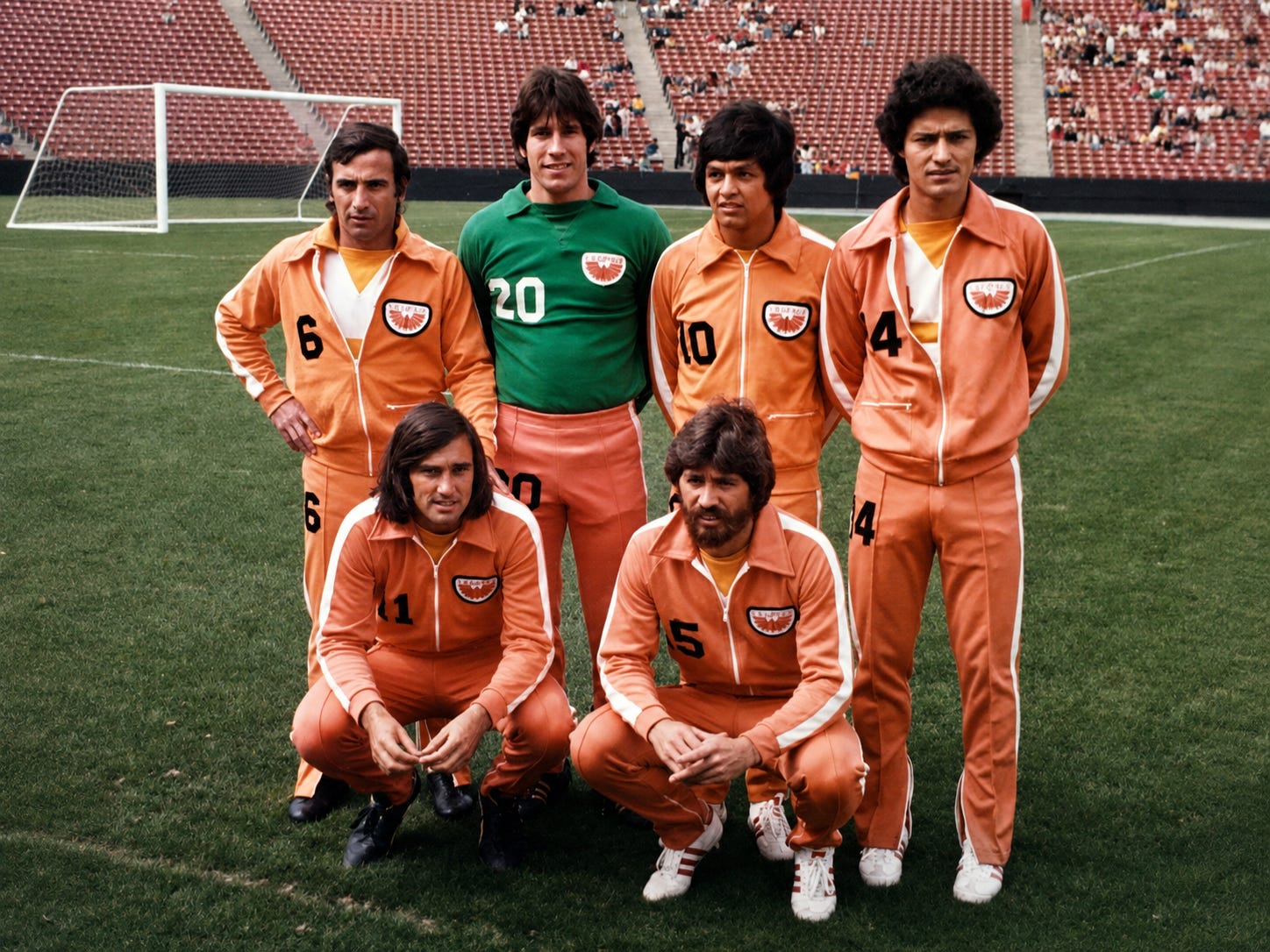
Los Angeles is too large for one football address.
The original Los Angeles Aztecs discovered that nearly fifty years ago.
Between 1974 and 1981, the club played outdoor home matches at Weingart Stadium, Murdock Stadium, the Los Angeles Memorial Coliseum and the Rose Bowl.
When the game moved indoors, the Aztecs played at the Forum and the Los Angeles Memorial Sports Arena.
Six venues.
East Los Angeles.
The South Bay.
Exposition Park.
Pasadena.
Inglewood.
The Aztecs moved across the city before touring sports became a business model.
At the time, much of that movement came from necessity. Owners changed. Costs changed. Ambitions changed. The club kept searching for the right ground.
We should be honest about that.
But history sometimes creates an idea before anyone understands it.
The old Aztecs left behind the route of a club that could belong to all of Los Angeles.
The revived Aztecs can now follow it with purpose.
Weingart Stadium: where it began
The story started at Weingart Stadium, at East Los Angeles College.
The first home game was played there in May 1974 against the Seattle Sounders.
The Aztecs won.
They kept winning.
By the end of their first season, they were champions of the North American Soccer League.
The club had barely learned to walk before it lifted a trophy.
East Los Angeles was the right place to begin. Football did not need to be introduced there by a marketing department. It already lived in the community, in families, on public pitches and in the culture carried north from Mexico and across Latin America.
The Aztecs were not bringing football to East LA.
East LA already understood it.
The club was entering football country.
That first home should never be treated as a temporary address. It was the foundation.
Murdock Stadium: George Best and the South Bay
For the 1975 and 1976 seasons, the Aztecs moved to Murdock Stadium at El Camino College.
The club went south.
Torrance.
Gardena.
Hawthorne.
Redondo Beach.
Hermosa Beach.
This became the Aztecs’ home when George Best arrived in Los Angeles.
Best did not live as a distant import, hidden in a hotel and driven to matches.
He became part of the South Bay.
He lived around Hermosa Beach. He drank there. He laughed there. He became involved with a local bar. People saw him in the streets as well as on the pitch.
For a time, one of the greatest footballers alive belonged to that part of Los Angeles.
The Aztecs belonged there with him.
Murdock was smaller than the giant arenas that followed. That was not always a weakness.
Football needs scale.
It also needs people close enough to hear the tackle.
The Coliseum: when the dream became enormous
The arrival of George Best demanded a larger stage.
In April 1976, the Aztecs played Pelé and the New York Cosmos at the Los Angeles Memorial Coliseum.
Nearly 30,000 people came.
Pelé against Best.
New York against Los Angeles.
The biggest name in world football against the man many believed had been the most naturally gifted.
The Cosmos won the match.
Los Angeles saw what the Aztecs could become.
The Coliseum became the club’s principal home in 1977. Elton John sat with the team there. George Best played there. The Aztecs reached the NASL semifinals.
It was a magnificent and dangerous place to play.
A large crowd made the Aztecs feel like one of the biggest clubs in America.
A smaller crowd could disappear inside the concrete.
That tension followed the old NASL everywhere.
It wanted tomorrow before the foundations of today were secure.
But for certain afternoons, the Coliseum held the dream.
The Rose Bowl: Cruyff came to Pasadena
The Aztecs moved to the Rose Bowl in 1978.
Then Johan Cruyff arrived.
Rinus Michels coached him.
For one season, Total Football came to Pasadena.
Cruyff was not merely a famous name reaching the end. He was still thinking faster than almost everyone around him. He was named the NASL’s Most Valuable Player in 1979.
That season produced the strongest average attendance in the club’s outdoor history.
People came to watch Cruyff receive the ball.
Then turn.
Then show them something they had not expected.
The Rose Bowl was huge. Often too huge. But it gave the Aztecs another part of Los Angeles.
Pasadena entered the story.
A football club leaves something behind each time it plays somewhere.
A child remembers a first match.
A father remembers taking him.
A player remembers the tunnel.
The club moves.
The memory stays.
The Forum and the Sports Arena
The Aztecs also played indoors.
They used the Forum in Inglewood during the 1979–80 indoor season and the Los Angeles Memorial Sports Arena during the campaign that followed.
Indoor football was fast and strange.
The walls kept the ball alive. The pitch was tight. The crowd was close. Football became mixed with theatre and controlled chaos.
Los Angeles understood theatre.
The Forum was already one of the great entertainment buildings in America. The Sports Arena carried a harder history of its own.
The Aztecs took football inside both.
Even then, the club kept moving towards new communities.
The final return
The Aztecs returned to the Coliseum for their final outdoor season in 1981.
That was where the road ended.
The club’s final outdoor home match came in a playoff defeat against the Montreal Manic. By the end of the year, the Aztecs were gone.
The old club had run out of money, stability and time.
The badge had not run out of meaning.
Companies close.
Leagues collapse.
Owners leave.
A football identity can survive all three.
Los Angeles is not one city
People who do not know Los Angeles often speak about it as one place.
It is not.
It is cities inside a city.
East LA is not Pasadena.
Pasadena is not Inglewood.
Inglewood is not Torrance.
Torrance is not the Valley.
The distances matter. The traffic matters. Asking a family to cross the whole region for a match is not always realistic.
The wider Los Angeles region approaches 20 million people.
At the top of the men’s professional game, it has two MLS franchises.
LA Galaxy.
LAFC.
Both have built real support. Both deserve respect.
This is not an argument against them.
It is an argument against the idea that two clubs are enough.
Two franchises cannot carry the complete football identity of a region this large.
Nor should they be expected to.
Football already exists everywhere in Los Angeles.
It is played in parks, schools, colleges and small-sided centres. It lives inside Mexican, Central American, South American, European, African and Asian communities.
Los Angeles does not have a shortage of football people.
It has a shortage of clubs able to turn those people into belonging.
The Aztecs were touring before touring became fashionable
Modern sports organisations talk about entering new markets.
They call it expansion.
They call it outreach.
They call it activation.
The Aztecs were moving around Los Angeles in the 1970s.
They played in East LA.
They went to the South Bay.
They staged major occasions at the Coliseum.
They took Cruyff to Pasadena.
They played indoor football in Inglewood and Exposition Park.
They did not call it a touring model.
Much of it came from instability.
But the route exists.
The old Aztecs crossed Los Angeles because they were searching for survival.
The revived Aztecs can cross it with purpose.
That is the difference.
We do not need to pretend a touring football club is a new invention.
It is already written into the history of the badge.
The stadium can change. The club must not.
The modern Aztecs should not be trapped inside one building and one postcode.
The club can play in East Los Angeles.
It can return to the South Bay.
It can take matches to Pasadena, Inglewood, the Valley, Orange County and communities beyond.
The ground may change.
The badge must not.
The shirt must not.
The football must not.
The relationship with the supporters must not.
This is not homelessness.
It is reach.
It is a club going to its people rather than demanding that every supporter fight traffic across a region the size of a small country.
A touring model can also recover something modern football has lost.
Occasion.
Each match can matter because it does not happen every week in the same place.
A match becomes an event.
The club arrives.
The supporters gather.
The football begins.
Then the Aztecs move on and leave another community carrying part of the story.
Home is bigger than an address
Football tells us that every club must have one permanent home.
Perhaps one day the Aztecs will.
But Los Angeles demands a larger understanding of the word.
Home is East Los Angeles, where the champions began.
Home is the South Bay, where George Best lived and played.
Home is the Coliseum, where Best faced Pelé and Elton John wore the badge.
Home is Pasadena, where Johan Cruyff taught the game.
Home is Inglewood and the old Sports Arena, where football went indoors and became a show.
The original Aztecs moved because they had to.
The new Aztecs can move because Los Angeles needs them to.
We can build a football club that is serious without becoming static.
Entertaining without becoming fake.
Ambitious without becoming another corporate franchise.
The Aztecs do not need to belong to one stadium.
They need to belong to the people.
The old grounds were never merely temporary addresses.
Together, they formed a map.
And that map tells us exactly where the Los Angeles Aztecs belong.
Everywhere.