

When people talk about bringing a football club back, the conversation normally starts with the stadium.
How many seats?
Where will it be?
Who pays for it?
How much parking is there?
I think that is starting at the wrong end.
The Los Angeles Aztecs should not simply build a stadium.
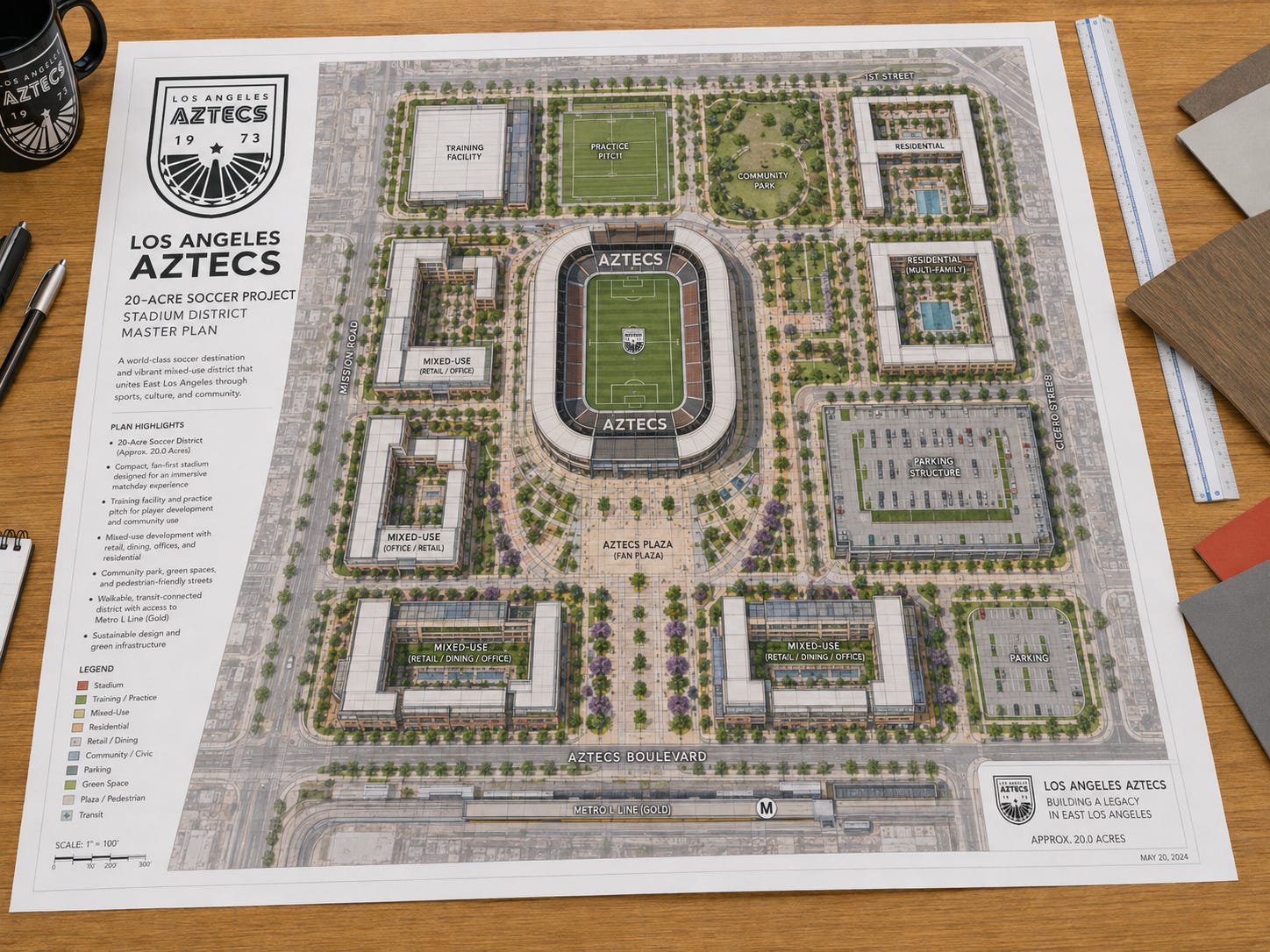
We should build an LA Aztecs Entertainment District.
The stadium can be the anchor.
Football can provide the identity.
But around it should be something considerably bigger: housing, restaurants, bars, hotels, independent businesses, offices, entertainment, public spaces, community football facilities and places people actually want to spend time.
Affordable housing should be part of that conversation too.
Because the objective shouldn’t be to arrive in a community, build a stadium, extract money from the surrounding area and go home.
The objective should be to leave the area better than we found it.
That distinction matters.
A Stadium That Works Seven Days a Week
Traditional stadium economics are strange when you think about them.
You construct an enormously expensive asset and then primarily monetise it when somebody is playing football inside it.
The smarter model is increasingly different.
The stadium becomes the anchor tenant for an entire district.
The Atlanta Braves’ Truist Park sits at the heart of The Battery Atlanta, a 2.25-million-square-foot mixed-use development containing restaurants, hotels, retail, entertainment and hundreds of residences. It operates as a destination throughout the year rather than simply on baseball days.
The Green Bay Packers developed Titletown beside Lambeau Field, combining commercial development with housing and a major public park designed for year-round community use.
St. Louis CITY SC says around $500 million of development had been invested in its surrounding City Commons district by 2024, excluding CITYPARK itself, with apartments, hotels, restaurants, retail and commercial development forming part of the wider investment story.
These projects aren’t identical.
And the Aztecs shouldn’t copy any of them.
But they prove something important.
Sport can create the anchor around which an entirely new piece of a city grows.
Los Angeles Already Understands the Principle
We don’t even have to leave Los Angeles to see it.
When LAFC broke ground on what is now BMO Stadium, the original development vision extended beyond the ground itself.
It included a public plaza, restaurants, retail and conference and event facilities, with the surrounding district intended to be active on non-matchdays throughout the year.
That principle was right.
The Aztecs have an opportunity to take the concept further.
Instead of asking:
Where can we put our stadium?
Ask:
What could this community become if football helped unlock the development?
That produces a completely different conversation.
Housing Has to Be Part of It
Los Angeles does not need another beautiful computer rendering completely disconnected from the people who already live nearby.
If an Aztecs district is going to mean anything, housing should sit alongside football and entertainment in the masterplan.
That means market-rate housing.
Workforce housing.
And, where financially and physically feasible, meaningful affordable housing.
Imagine families living within walking distance of the stadium.
Young people playing football outside it.
Local restaurants trading seven days a week.
Independent businesses occupying units around the development.
Public plazas hosting markets, screenings, concerts and community events.
Training, education and community programmes operating during the week.
People working there.
People living there.
People actually using the place.
Then on matchday, the same neighbourhood becomes the home of the LA Aztecs.
That is considerably more interesting than building 10,000 seats in the middle of an enormous car park.
But Community Benefits Have to Be Paid For
This is where the conversation has to become more grown-up.
Affordable housing costs money.
Public parks cost money.
Youth pitches cost money.
Infrastructure costs money.
You cannot simply write “community” on a presentation deck and hope somebody else pays for it.
So the district needs an economic engine.
The broad principle would be a mixed-use development in which revenue-producing components — potentially market-rate residential, hospitality, retail, commercial development, events, sponsorship, parking and football operations — help support the economics of the wider destination.
Private development capital would sit alongside whatever public financing mechanisms are appropriate for the chosen city and site.
California’s Enhanced Infrastructure Financing Districts, for example, allow participating local governments to dedicate portions of future property-tax increment toward qualifying infrastructure and development projects. Current regional guidance describes EIFDs as tools capable of supporting infrastructure, housing and climate-related investment.
That does not mean asking a city to write the Aztecs a cheque.
It means asking whether football-led private investment can create sufficient additional economic activity to unlock infrastructure and public benefits that neither side could reasonably deliver alone.
Private capital.
Development value.
Public infrastructure tools where appropriate.
Long-term economic activity.
One capital stack serving one larger place-making strategy.
That is how the community element stops being charity bolted onto a stadium and becomes part of the economics of the district itself.
The Fans Should Own Part of the Football Club
This is the piece that could make the Los Angeles Aztecs genuinely different.
Supporters should have the opportunity to own equity in the football club.
Not just merchandise.
Not NFTs.
Not a meaningless supporters’ certificate hanging on the wall.
Real economic participation.
But it also has to be structured properly.
No institutional investor or development partner wants thousands of individual names cluttering a cap table or thousands of people voting on whether the club should sign a left-back.
So fan participation needs professional architecture.
One possibility would be pooling supporters through a dedicated fan investment vehicle — potentially an SPV, trust or similar structure — which appears as a single ownership block at the club level.
Any public offering would need to use an appropriate securities-law pathway and be structured by qualified US securities counsel. Regulation A, for example, is an SEC exemption that permits eligible companies to conduct qualifying public securities offerings under defined rules and limits.
The exact mechanism comes later.
The principle comes first.
Supporters should be capable of sharing in the financial upside of the club while professional investors retain a clean and workable governance structure.
That is not fan ownership as theatre.
It is supporters participating economically in the institution they are helping create.
There is an enormous difference between a customer and an owner.
If thousands of people genuinely have a stake in the Aztecs, the relationship changes.
The club grows?
They participated.
The stadium opens?
They helped make the journey possible.
The value of the club increases?
They aren’t simply watching somebody else capture all of it.
Instead of continually extracting value from supporters, we should explore how we can create value alongside them.
We Also Understand California Is California
There is another reality that cannot be ignored.
You do not wake up on Monday morning in Los Angeles with a stadium idea and start pouring concrete on Friday.
Major California development means planning.
Zoning.
Environmental review.
Infrastructure.
Community consultation.
Labour.
Transport.
Entitlements.
And lawyers.
Lots of lawyers.
California substantially changed parts of its housing and CEQA framework in 2025, including new streamlining and exemptions for qualifying infill housing and infrastructure projects. But whether any particular Aztecs development qualifies will depend on its site, design and approvals.
So our answer isn’t pretending those issues don’t exist.
It is designing around reality from day one.
That means favouring sites where existing planning policy supports development.
Considering infill and previously developed land.
Prioritising transport accessibility.
Reducing unnecessary car dependence where possible.
Building housing into the masterplan.
Engaging the host city early rather than presenting a finished plan and demanding approval.
And discussing labour alignment with California building trades, including whether a Project Labor Agreement makes sense for the eventual project.
California already has extensive prevailing-wage and apprenticeship requirements around qualifying public works, so labour strategy cannot sensibly be treated as something to think about at the end.
Entitlement strategy is part of site selection.
Not something we discover after buying the land.
That distinction could save years.
So What Does an Aztecs Site Actually Need?
We are currently examining six potential sites across the wider Los Angeles area.
And we are beginning conversations with cities about finding the right long-term home for the LA Aztecs.
No final location has been chosen.
That is deliberate.
Because we are not simply looking for an empty piece of land where somebody will allow us to put a pitch.
Our working criteria are much broader.
Ideally, a site should offer approximately 15–25 acres or more of contiguous development opportunity, depending on density, parking strategy and surrounding parcels.
It should have strong access to major roads and, where realistically available, LA Metro, Metrolink, light rail or other high-capacity public transport.
It needs sufficient infrastructure capacity.
It needs room not merely for a stadium but for a mixed-use destination.
Infill, underutilised commercial land, brownfield redevelopment and larger regeneration sites are particularly interesting because football can potentially become the catalyst for changing how the land is used.
We are also evaluating:
local population and demographics;
distance from existing professional sports competition;
commercial catchment;
housing demand;
land control;
planning and zoning;
transport;
potential development density;
infrastructure requirements;
public-sector appetite;
and whether the surrounding community actually wants us there.
Because the best financial deal on the wrong site is still the wrong deal.
We Want a City Partner, Not Simply a Landlord
This is why our conversations with cities can be much bigger than:
Can we rent your stadium?
That model doesn’t particularly interest me.
The conversation should instead be:
Could an underused piece of land become a destination?
Could football help unlock private development capital?
Could new housing be created?
Could affordable homes form part of the masterplan?
Could restaurants and independent businesses benefit?
Could youth football become permanently embedded in the development?
Could public space be created?
Could the venue bring concerts, events and visitors into the area?
Could investment in transport, utilities or streetscape unlock a substantially larger private development?
Could new tax-generating activity help fund infrastructure over time?
Now we aren’t discussing a football ground.
We are discussing economic development.
And that opens the door to considerably more partners.
Developers.
Real-estate investors.
Infrastructure funds.
Housing specialists.
Hospitality companies.
Entertainment operators.
Universities.
Healthcare providers.
Local businesses.
Building trades.
Community organisations.
Transport authorities.
Cities.
And supporters.
Football becomes the glue connecting them.
Community Asset, Not Corporate Island
There is still a danger.
“Entertainment district” can very quickly become corporate language for luxury apartments, expensive restaurants and a sports venue dropped into somebody else’s neighbourhood.
That isn’t the Aztecs vision.
If we push existing residents away, exclude independent businesses and build somewhere local families cannot afford to enjoy, then calling ourselves a community club would be nonsense.
Success should therefore be measured by more than attendance.
How many jobs did we create?
How much housing?
How much affordable housing?
How many local businesses operate there?
How many children use the football facilities?
How many days each year are the public spaces active?
How much private capital did football unlock?
What happened to the surrounding neighbourhood?
Did we actually make it better?
A football club should improve the place it calls home.
Otherwise it is merely occupying it.
History Gives the Aztecs Something Most Start-Ups Cannot Buy
This development also needs an identity.
Fortunately, we already have one.
George Best played for the Los Angeles Aztecs.
Johan Cruyff played here.
Rinus Michels coached here.
The club belongs to an extraordinary period of Los Angeles sporting history.
That matters.
Nobody develops an emotional attachment to Mixed-Use Development Parcel 6B.
People form emotional relationships with clubs.
Colours.
Players.
Stories.
Rivalries.
Matchdays.
Memories.
History.
The Aztecs can provide the cultural anchor around which the entire destination is built.
Not a museum dedicated to what happened fifty years ago.
A historic club providing the identity for something entirely new.
Build the Place. Build the Club. Build It Together.
The conventional American sports model often begins with securing league rights and finding somewhere to play.
I think we should think bigger.
Build the ownership base.
Find the right city.
Control the right land.
Assemble the right development partners.
Build the commercial ecosystem.
Create the community facilities.
Create the housing.
Create somewhere people want to visit whether the Aztecs are playing or not.
Then put football at its heart.
Imagine arriving three hours before kick-off.
Your kids play football.
You have lunch at an independent restaurant.
Supporters fill the plaza.
There is live music outside.
Families living nearby walk to the stadium.
Businesses are trading.
Thousands go inside.
The Aztecs play.
The final whistle goes.
And instead of everyone immediately climbing into their cars and disappearing, the district remains alive.
People eat.
Drink.
Meet.
Stay.
Live.
Work.
Return tomorrow.
That is not merely a football stadium.
That is a place.
And that is what I want the future home of the Los Angeles Aztecs to become.
A home for the club.
A destination for Los Angeles.
An economic engine for its community.
A place where people can live, work and build businesses.
A development capable of creating affordable housing and public space alongside commercial return.
A football club in which supporters can genuinely participate in the upside.
And above all:
A community asset with the LA Aztecs at its heart.
We are currently examining six potential sites and talking to cities across the Los Angeles area.
We want to hear from developers, investors, landowners, city leaders, housing partners and people capable of helping us put the capital and development structure together.
Because the search for the next home of the Los Angeles Aztecs has already started.
We just aren’t looking for a stadium.
We’re looking for somewhere to build the next chapter of Los Angeles.
Very ambitious mate, and I love it, it makes sense, but sadly the world tends to operate in doing things that often don’t make sense, humans at their destructive best.
I’d love to make this happen with you, still maintain it needs feet on the ground in LA to get this to a place where it could happen.