

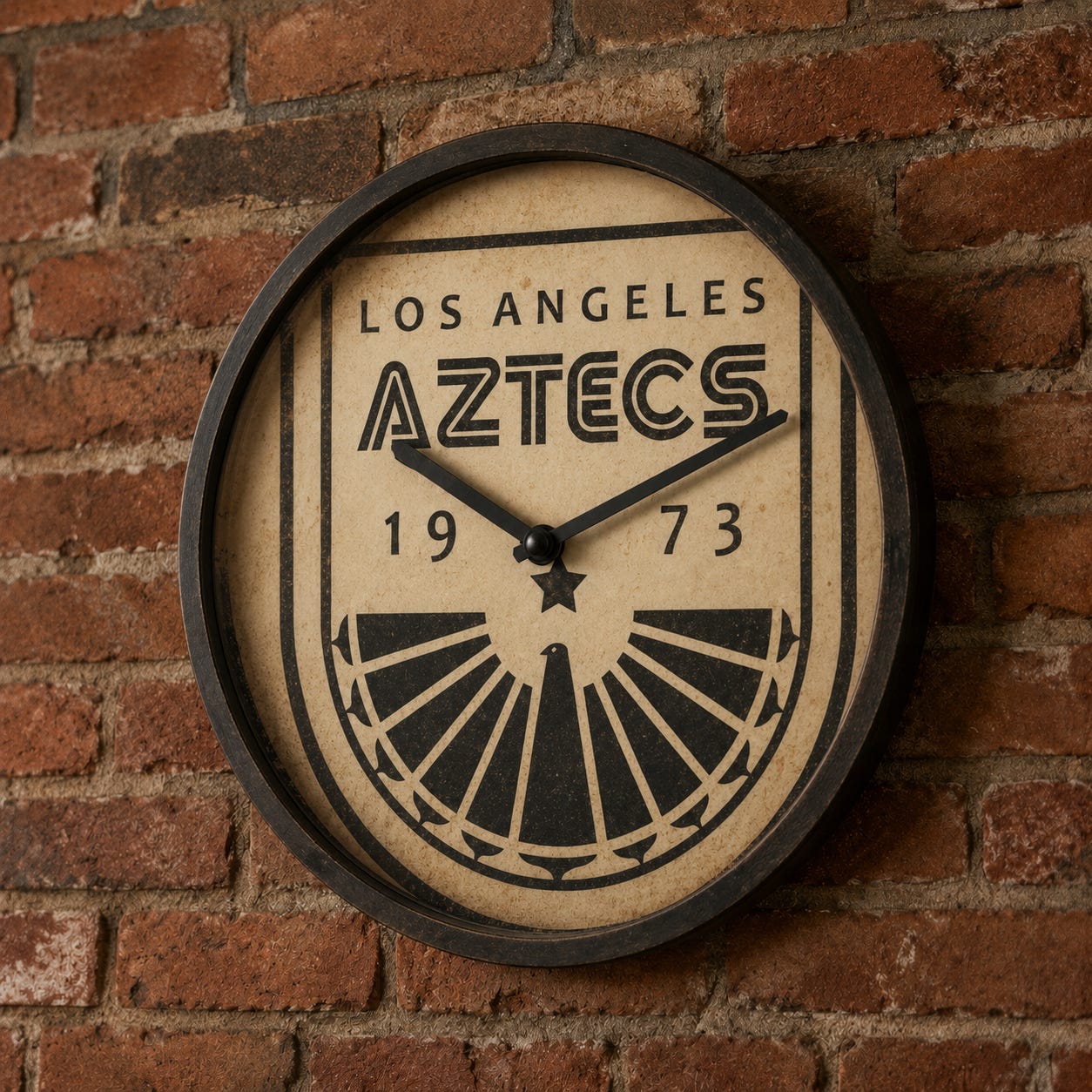
The Los Angeles Aztecs disappeared in 1981.
The name did not.
That is the strange thing.
George Best.
Johan Cruyff.
Rinus Michels.
The Rose Bowl.
Los Angeles in the seventies.
Football mixed with celebrity, music and enough chaos to give a modern compliance department a nervous breakdown.
The Aztecs arrived in the NASL in 1974.
They won the championship in their first season.
Seven years later, they were gone.
That should have killed the name.
It didn’t.
People Kept Coming Back
Over the decades, different people and organisations looked at the Los Angeles Aztecs and reached roughly the same conclusion.
There is still something here.
Trademark applications came and went.
Some became registrations.
Some did not.
The old NASL itself pursued the identity.
There were merchandise plans.
There were football ambitions.
There were attempts to bring something back.
Yet forty-five years later, the important bit still has not happened.
No lasting Los Angeles Aztecs football operation returned to the field.
I don’t see that as proof the idea is bad.
I see almost the opposite.
People do not keep returning to worthless things for forty years.
The name was never the problem.
Execution was.
And execution is where this attempt has to be different.
A Trademark Cannot Score
I have spent enough time around football trademarks to know what they are.
Useful.
Important.
Sometimes expensive.
Usually painful.
But they are not football clubs.
A trademark cannot score a goal.
It cannot sell a ticket.
It cannot find a centre-half.
It cannot convince a kid in Los Angeles that this is his club.
It cannot win on Saturday.
Paper matters.
But paper is not the product.
Football is.
This Is Why Class 41 Matters
Class 25 matters.
Clothing.
Shirts.
Merchandise.
Commercially, it matters a lot.
We intend to build it.
But Class 41 is the one that matters most to me.
That is where the football lives.
Games.
Events.
Tournaments.
Training.
Football services.
Put simply:
Class 25 puts the Aztecs on shirts.
Class 41 puts the Aztecs back on the field.
That is the difference.
I did not get involved with the Los Angeles Aztecs because I wanted to become the curator of a seventies clothing label.
There are easier ways to lose money and sleep.
I want football.
The USPTO Gives Us A Clock
America does not let someone reserve an intent-to-use trademark forever while doing nothing with it.
Fair enough.
There are deadlines.
There are six-month periods.
There are extensions.
Eventually the runway ends.
And eventually there has to be real use.
Not a website.
Not another presentation.
Not a CGI stadium with palm trees, craft beer and several suspiciously happy families walking past it.
Real activity.
Good.
Football has enough PowerPoints.
My Target Is 2027
The legal runway is not my business plan.
It is the backstop.
My target is much simpler.
Put the Los Angeles Aztecs back on a football field in 2027.
That first match does not need to look like Year Ten.
It shouldn’t.
We do not need the final stadium first.
We do not need the final league first.
We do not need a huge ownership group first.
We do not need to pretend we are Manchester United because somebody printed some hospitality passes.
We need:
A venue.
Players.
Coaches.
Officials.
Supporters.
Sponsors.
Tickets.
A ball.
Then we play.
Match One Does Not Need The Forever Home
A permanent home matters.
Of course it does.
A serious football club needs somewhere supporters eventually call theirs.
But I refuse to let the search for the perfect permanent site stop us playing Match One.
That would be madness.
Municipal planning can take years.
Development can take longer.
Millions can disappear before anyone has kicked anything.
So the plan is simple.
Secure an appropriate temporary home for the first phase.
University ground.
Municipal stadium.
Existing football facility.
Whatever makes commercial and sporting sense.
And while the team plays, we continue working on the permanent home.
The next concrete milestone is straightforward:
secure a venue agreement for the 2027 launch programme.
Not a fantasy rendering.
Not “conversations.”
Something on paper.
A place where football can actually happen.
Prove It Before You Scale It
Football owners have a wonderful habit.
They build the penthouse before checking whether anybody wants an apartment.
I want to do the opposite.
Start smaller.
Measure everything.
Then grow.
The first Aztecs football programme could be a short run of exhibitions.
Three matches.
Five matches.
Enough to test the proposition properly.
Not one novelty evening followed by a victory lap on LinkedIn.
A genuine test.
We measure:
Attendance.
Paid attendance, not freebies.
Ticket revenue.
Sponsorship.
Merchandise.
Digital growth.
Repeat customers.
Local press.
Broadcast interest.
Cost per match.
Revenue per supporter.
And most importantly:
does anyone care enough to come back?
That is the question.
The First Capital Buys Evidence
This matters to investors.
The first raise does not need to finance the finished Los Angeles Aztecs.
That would be ridiculous.
The first capital needs to finance proof.
Venue.
Squad.
Coaching.
Officials.
Insurance.
Security.
Match operations.
Marketing.
Content.
Ticketing.
A properly promoted launch slate.
Then a contingency reserve.
That’s it.
No $20 million league cheque.
No stadium construction.
No enormous payroll because somebody thinks football credibility is measured by how quickly you can empty a bank account.
No Year Ten spending in Year One.
Before that launch capital is deployed, the operating budget should be built from real venue quotes and real match costs.
Then we ring-fence it.
We set the maximum downside.
We know what failure costs before we start.
The first capital should buy evidence, not ego.
We Put A Limit On Failure
I do not believe in proving demand by endlessly subsidising something nobody wants.
That isn’t proof.
That is charity with floodlights.
Early football activity needs a loss limit.
A real one.
If people come, we add matches.
If sponsors engage, we grow.
If merchandise moves, we produce more.
If the economics improve, we invest.
If they don’t, we stop.
Learn.
Change something.
Then test it again.
What we do not do is keep burning investor cash and announce that everything is fantastic because “awareness is growing.”
Football has heard that one before.
I Am Not Picking A League To Look Serious
People ask:
USL?
MLS NEXT Pro?
Another pathway?
It is a fair question.
But I am not going to pick a league today because it makes a slide deck look more grown-up.
League membership is not a trophy.
It is a commercial decision.
First we get the data.
Venue economics.
Attendance.
Sponsorship.
Operating cost.
Capital requirements.
Supporter demand.
Then we choose.
Maybe a league is worth paying for.
Maybe it isn’t.
Maybe the right opportunity looks very different by then.
That is the point.
Information creates leverage.
I would rather enter the right competition twelve months later than pay millions to enter the wrong one twelve months early.
The Sequence Matters
The order is important.
Build the audience.
Then:
Secure the temporary venue.
Then:
Fund the launch slate.
Then:
Play football.
Then:
Measure everything.
Then:
Decide whether to scale.
Then:
Choose the right league and permanent-home strategy from evidence rather than hope.
Every stage earns the next one.
That is how you de-risk a football club.
Not by removing risk.
Football will never be risk-free.
By refusing to pay for risks you do not yet need to take.
Why This Matters In Los Angeles
Los Angeles does not need another sports brand demanding attention because its marketing agency says it deserves some.
There is plenty of competition.
The next generation will not support the Aztecs because Johan Cruyff played for them.
Nor should they.
History gets us through the door.
It does not keep anybody in the room.
The real victory will come when a kid in Los Angeles wears an Aztecs shirt and knows almost nothing about 1979.
He does not care who George Best was.
He cares that the Aztecs won 2-1 last night.
Good.
That means we did it.
Nostalgia has become culture.
History has become somebody else’s present.
That is how a forty-five-year-old football name becomes young again.
We Are Not Building A Museum
I love the old Aztecs.
The pictures are brilliant.
The stories are brilliant.
Best.
Cruyff.
Elton John.
Hollywood.
All of it.
But I do not want to embalm the club.
I want to continue it.
A football club cannot live forever in sepia photographs.
Eventually somebody needs to dirty the shirt.
We are not trying to build the world’s greatest memorial to the Los Angeles Aztecs.
We are trying to build the next Los Angeles Aztecs.
That is harder.
It is also far more interesting.
The First Match Changes Everything
For more than forty years, the Aztecs have existed mostly through memories, shirts, photographs and stories.
Then eleven players walk onto a field wearing the badge.
A referee blows the whistle.
The ball moves.
Suddenly it is not history anymore.
It is football.
That first match will not mean we have succeeded.
It will mean we have finally started.
Then comes Match Two.
Then Match Three.
Then supporters who come back.
Then sponsors.
Then players people recognise.
Then rivalries.
Then a permanent home.
Then the bigger decisions.
One proof point at a time.
Deadlines Are Good
I like the clock.
Without deadlines, football projects can remain “in development” forever.
Another adviser.
Another consultant.
Another feasibility study.
Another rendering.
Another stakeholder engagement meeting.
Another year.
Everyone gets paid.
Nobody gets tackled.
No.
The clock is running.
Good.
Managers get Saturdays.
Players get ninety minutes.
Founders should not get forever.
2027
That is the first line in the sand.
Put the Los Angeles Aztecs back on the field.
Not perfectly.
Not extravagantly.
Properly.
Secure the venue.
Ring-fence the money.
Cap the downside.
Play the matches.
Measure the response.
Earn the right to make the next decision.
Because after forty-five years, I am not interested in being another person who recognised the value of the Los Angeles Aztecs.
Plenty of people managed that.
I want us to be the people who finally finished the job.
The paperwork protects the name.
Football brings it back to life.