

A tribute from the Los Angeles Aztecs
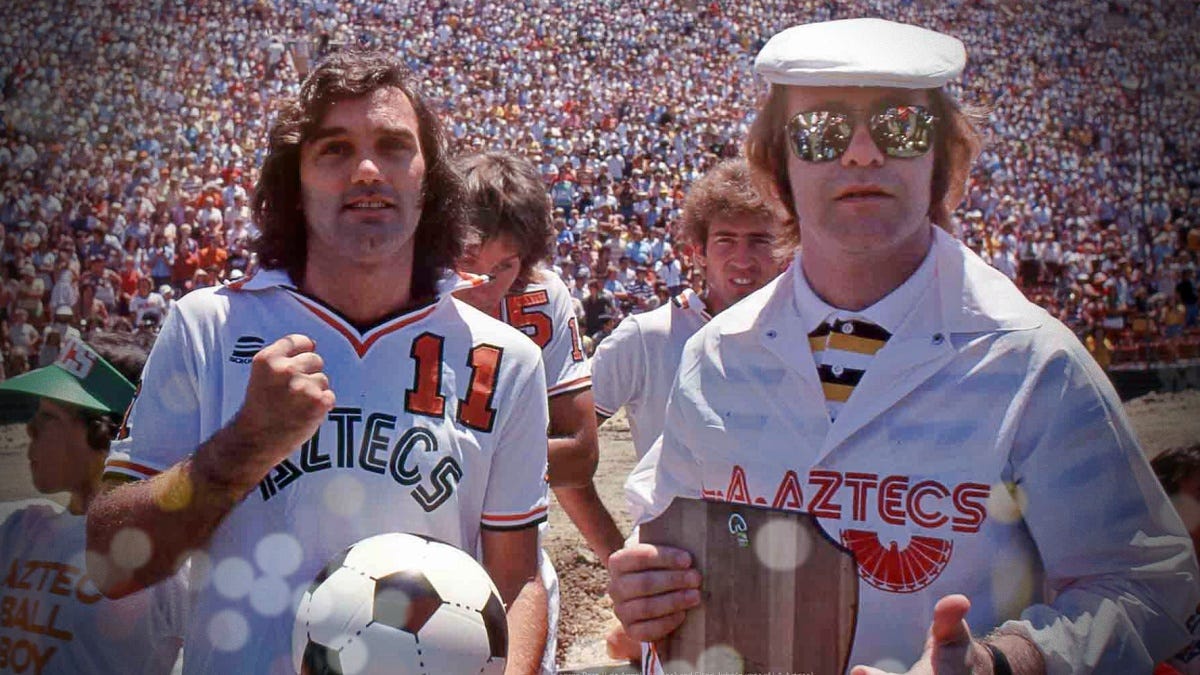
There is a photograph of Elton John and George Best at the Los Angeles Coliseum.
George is wearing the white and orange of the Aztecs. The ball is tucked against his hip. His hair is long. His face still carries the calm arrogance of a man who knows he can beat anyone.
Elton stands beside him.
White cap. White glasses. Aztecs shirt.
The stadium rises behind them.
It should look ridiculous.
It does not.
It looks right.
Because Elton John was never a celebrity pretending to love football.
He loved it before ownership became theatre. Before famous names bought clubs for streaming documentaries, global exposure and another line on an investment portfolio.
He did not need football to make him important.
He was already Elton John.
He came because the game mattered to him.
That is the difference.
And it is everything.
By 1976, Elton could have walked into almost any room in the world and become its centre.
The records had sold. The arenas were full. The clothes were louder than the amplifiers. Fame followed him everywhere.
Yet when George Best arrived in Los Angeles, Elton went to meet him wearing the colours of the club.
Not a suit.
Not a sponsor’s jacket.
The kit.
A contemporary report described Elton arriving at the Coliseum in orange and white to welcome the Aztecs’ newest player. The star at the piano had come to greet the star with the ball. Elton was then part-owner of the club. George had crossed the Atlantic to play for it.
Two men from Britain stood beneath the California sun.
Neither had been born into privilege.
Neither had waited for permission.
Both had discovered something they could do better than almost anyone alive.
George could take a football into a crowd of defenders and come out with it.
Elton could sit at a piano, strike the first chord and make a stadium feel less alone.
They understood performance.
More importantly, they understood that performance without substance was fraud.
Elton could wear the feathers, the sequins and the glasses because the songs held up when all of it was removed.
George could live like a film star because, when the whistle blew, he still had to beat his man.
And he did.
That is why they belonged together in Los Angeles.
Not because they were famous.
Because they could deliver.
Elton, George and the Aztecs
The Aztecs did not sign a faded photograph of George Best.
They signed George Best.
He scored 15 league goals in his first season in Los Angeles. The following year, he led the NASL with 18 assists, supplying chances for Steve David as the Aztecs pushed deep into the competition. He was still capable of making a match turn with one touch, one feint or one run that nobody else had seen.
Elton understood what Best could give Los Angeles.
The city did not need another polite football team asking to be noticed.
It needed danger.
It needed colour.
It needed someone who could make a child in the stand lean forward because something might happen.
George was that man.
Elton was not the football expert pretending he had discovered him. He was something more useful.
He was a believer.
He knew that football could not survive on administration alone. A club needed players who made people care. It needed a story. It needed nerve. It needed enough imagination to become larger than a fixture list.
That was what the old North American Soccer League understood at its best.
It made mistakes. It spent too much. It ran too quickly. It sometimes mistook noise for foundations.
But it dared.
It brought Pelé to New York.
It brought George Best and, later, Johan Cruyff to Los Angeles.
It tried to make football matter in a country that had not yet decided what to do with it.
Elton did not stand at a distance from that attempt.
He joined it.
He trained with the players. He appeared beside the pitch. He wore the badge. The league’s most recognisable celebrity owner did not act embarrassed by his enthusiasm. He looked delighted to be there.
There is honesty in those old pictures.
Elton does not look like a man completing a commercial obligation.
He looks like a supporter who has somehow been allowed onto the grass.
That is what he was.
A supporter with extraordinary reach.
A supporter with enough fame to make the world turn its head.
But still a supporter.
Modern football should study the distinction.
Celebrity is not the problem.
Vanity is.
Money is not automatically the enemy.
Entitlement is.
A famous owner who listens, contributes and respects the club can add something.
An owner who treats the badge as personal content takes something away every time he appears.
Elton brought attention to the Aztecs.
But he did not demand that the Aztecs become a monument to Elton John.
The badge remained the point.
The football remained the point.
George remained the point.
Elton knew when to step into the light.
He also knew when the light belonged to someone else.
That is rare in show business.
It is almost extinct in football ownership.
The proof was Watford
Los Angeles was not a passing flirtation with the game.
Watford proved that.
Elton had supported the club as a boy. He became chairman in 1976 and appointed Graham Taylor the following year.
It was not a fashionable appointment.
It was the right one.
Watford were in the Fourth Division. They were not a global brand. There was no glamour in the table and little romance in the accounts.
Elton backed Taylor anyway.
Then he allowed him to work.
Watford climbed through the divisions. They reached the top flight, finished second behind Liverpool in 1982–83 and walked out at Wembley for the 1984 FA Cup final. Elton’s relationship with the club has endured, and he remains its Honorary Life-President.
It is one of the great stories in English football.
Not because a rich man bought success.
Because two men understood their jobs.
Graham Taylor managed the football.
Elton John supported him.
The chairman did not keep appearing in the dressing room with tactical opinions. He did not sack the manager after three bad Saturdays. He did not demand a fashionable signing to impress friends over dinner.
He chose a good football man.
He gave him belief.
He stood behind him.
That sounds almost revolutionary now.
It should be ordinary.
Elton’s Watford were ambitious without being ashamed of where they came from. They did not need to erase their identity to move forward. They did not become a corporate shell wearing an old club’s colours.
They rose as Watford.
That is proper ownership.
You do not rescue a club by turning it into yourself.
You give it the strength to become more fully what it already is.
Elton understood that.
Many billionaires never will.
The man beneath the costume
The stage clothes made Elton impossible to ignore.
They also allowed lazy people to underestimate him.
Behind the glasses was a survivor.
A man who had known addiction, shame, excess and the loneliness that can exist inside enormous success.
He did not come through those years and close the door behind him.
He used his name.
He used his money.
He used the microphone.
In 1992, he established the Elton John AIDS Foundation. Since then, it has fought not only HIV but the fear, prejudice and abandonment surrounding it. The work has supported vulnerable people whom governments, institutions and respectable society too often preferred not to see.
That tells us more about Elton John than any costume ever could.
The clothes were loud.
The compassion was louder.
He understood something football also forgets.
People matter most when they are struggling.
It is easy to stand beside winners.
It is harder to stand beside people the world has already judged.
Elton did both.
He stood beside famous footballers.
He also stood beside the frightened, the sick and the excluded.
He did not always do it quietly.
Good.
Silence was already part of the problem.
What Elton means to the Los Angeles Aztecs
Elton’s formal ownership of the Aztecs did not last forever.
Nothing does.
But importance cannot always be measured in years.
Some people remain at a club for decades and leave no mark beyond invoices and bad decisions.
Others pass through briefly and become part of its soul.
Elton helped give the Aztecs scale.
Not financial scale.
Imaginative scale.
He showed that this young Los Angeles club could stand beside the biggest names in sport and culture without apologising for being there.
The Aztecs were not merely an American experiment.
They were a football club with enough nerve to bring together George Best, Elton John and Los Angeles.
That combination should have been impossible.
For a while, it was real.
That matters to us now.
Because the Los Angeles Aztecs badge is alive again.
But revival cannot mean taking an old name, polishing it and selling nostalgia back to people.
That would be easy.
It would also be worthless.
The duty is greater than that.
We must recover the courage behind the name.
The Aztecs must be bold without becoming hollow.
Entertaining without becoming false.
Ambitious without forgetting the supporters.
We must build a club that welcomes attention but is never owned by it.
A club where famous people may stand beside us, but never above us.
A club that understands the badge belongs to those who carry it, follow it and keep it alive.
That is the lesson Elton left us.
He did not arrive in Los Angeles to take football from anyone.
He came to add something.
Energy.
Belief.
Possibility.
He understood that fame should serve the club.
The club should never serve the fame.
One of us
Sir Elton John belongs to Watford.
We would never pretend otherwise.
That is his club. His boyhood love. His great football work.
But there is room in a football heart for more than one memory.
Part of Elton’s story will always live in Los Angeles.
It is there in the old photographs.
The white glasses.
The orange shirt.
The Coliseum.
George Best beside him.
The ball between them.
Two showmen who knew the show still had to be good.
Two men who crossed the Atlantic without leaving themselves behind.
Two men who made people look.
Then gave them something worth seeing.
Sir Elton, we remember what you brought to our club.
Not merely your name.
Not merely the cameras.
Not merely the moment.
You brought belief.
You believed football could take root in Los Angeles.
You believed George Best still had magic in his boots.
You believed a club could be serious without becoming dull, colourful without becoming fake and ambitious without surrendering its soul.
You were right.
The world has changed since those days at the Coliseum.
Football has become richer.
It has not always become better.
Owners have become more visible.
Too many have become less human.
The game now has more money than it knows how to spend and less loyalty than it knows how to admit.
That is why your example matters.
You did not borrow football’s credibility.
You gave football yours.
You did not wear the badge because it made Elton John look bigger.
You wore it because the badge meant something to you.
We have not forgotten.
We will not forget.
The Aztecs are back.
The badge lives.
And wherever this journey takes us, there will always be a place in our story for the man in the white glasses who stood beside George Best beneath the California sun.
You were one of us then.
You still are.