

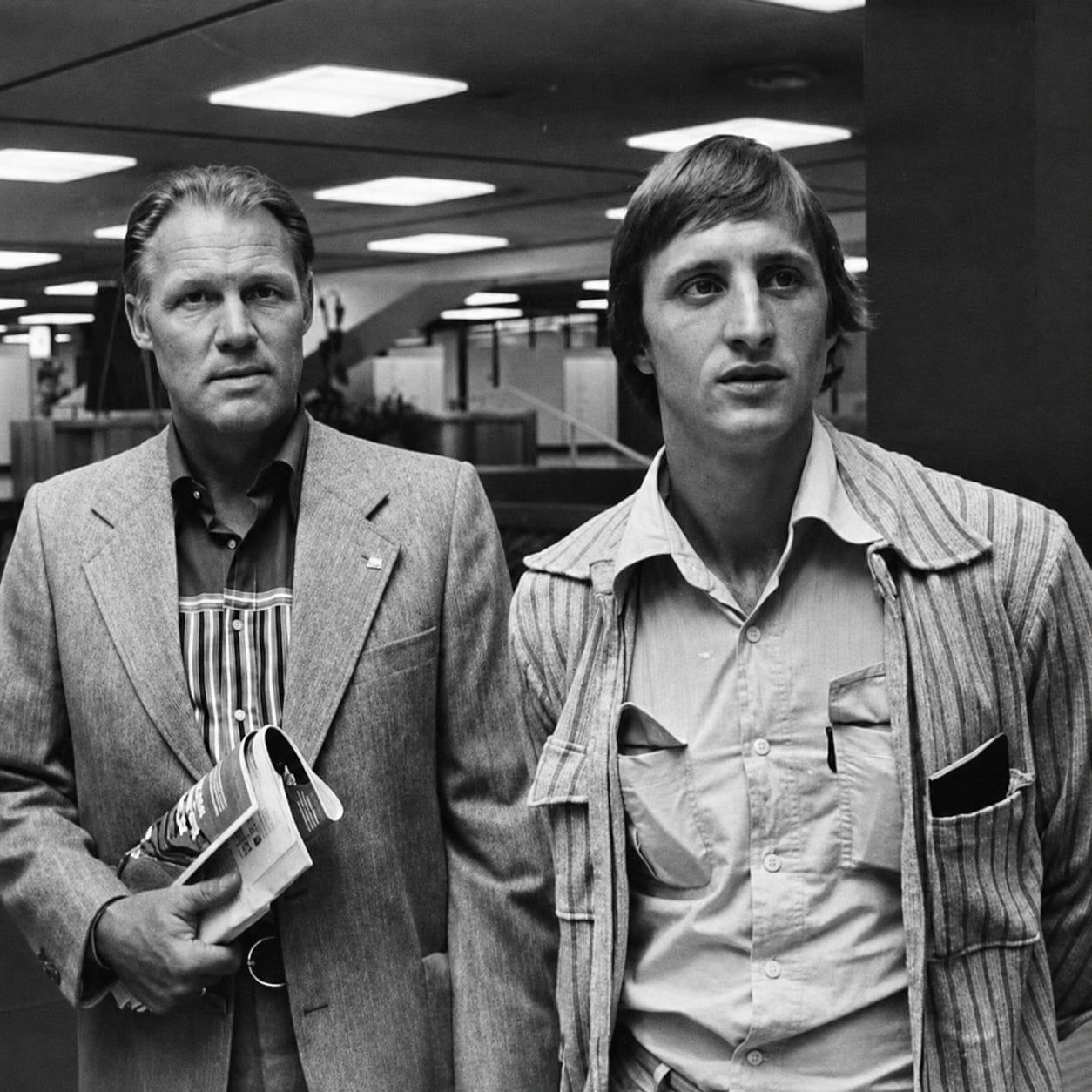
Rinus Michels did not come to Los Angeles for retirement.
That matters.
When the LA Aztecs hired him ahead of the 1979 season, Michels had already transformed Ajax, won the European Cup, won La Liga with Barcelona and taken the Netherlands to the 1974 World Cup final.
He was not some famous old name being wheeled out for American soccer.
He was 50.
His greatest international trophy was still nine years away.
In 1988 he would lead the Netherlands to the European Championship. In 1999, FIFA named him its Coach of the Century.
And in between those landmarks sits a chapter football history too often treats as a curiosity.
Los Angeles.
The architect
Michels is usually described as the father or architect of Total Football.
The phrase can make it sound more complicated than it was.
His football was based on a simple idea executed with extraordinary intelligence.
Players could move.
The team could not fall apart.
A defender went forward, somebody covered him. A midfielder dropped, another player occupied the space. Everyone had to understand more than his own position. Everyone attacked. Everyone defended.
Freedom, but with responsibility.
FIFA describes Michels as the man who developed Total Football and turned Johan Cruyff into its greatest interpreter. Ajax still regards his philosophy as the foundation for much of what followed at the club.
Michels understood space before football employed departments of analysts to give it complicated names.
He also understood that beautiful football required discipline.
That was the contradiction.
Cruyff looked like freedom.
Michels built the structure that allowed the freedom to exist.
They needed each other.
Then Los Angeles called
The Aztecs had already lived a ridiculous amount of football history in a very short time.
They had won the NASL championship in their first season in 1974.
Elton John became involved with the club.
George Best arrived.
Then Best left.
Ownership changed.
Stadiums changed.
The Aztecs had glamour, but not stability.
Then came Michels.
The Los Angeles Times later recalled that Aztecs owner Alan Rothenberg brought Michels to Los Angeles and Michels, in turn, brought the city Johan Cruyff.
That relationship changes how we should view Cruyff’s American adventure.
Cruyff did not simply wake up one morning and decide Southern California looked pleasant.
He wanted to play for Michels.
They had worked together at Ajax.
They had worked together at Barcelona.
They had taken the Netherlands to a World Cup final.
They had already changed football together.
The Washington Post later reported that Cruyff preferred the Aztecs partly because Michels was there and had assembled players who understood the football they wanted to play.
That is an important distinction.
The Aztecs didn’t just sign Johan Cruyff.
They created the environment that made Johan Cruyff want to play for them.
May 1979
The original Aztecs press release announcing Cruyff survives.
It is magnificent.
Dated May 22, 1979, it declares:
“The greatest soccer player in the world is now a Los Angeles Aztec.”
Subtlety had apparently not reached Pasadena.
Cruyff made his NASL debut the following evening at the Rose Bowl.
Within seven minutes he had scored twice.
He finished the regular season with 13 goals and 16 assists in 23 appearances.
Then the NASL players voted him the league’s Most Valuable Player.
Cruyff was extraordinary.
But reducing Michels’ Los Angeles period to “the year Cruyff played there” misses the more interesting story.
Michels built a team
The 1979 Aztecs finished 18–12.
Michels then returned for 1980.
Cruyff didn’t.
After an ownership change, Cruyff was sold to the Washington Diplomats. Michels suddenly had to prove he could take the Aztecs forward without the greatest footballer he had ever coached.
He did.
The 1980 Aztecs went 20–12.
That gave Michels a two-season regular-season record in Los Angeles of 38 wins and 24 defeats. The club’s own postseason guide described the 20 victories as a team record.
And the numbers underneath that record are revealing.
Los Angeles scored 61 goals.
They went 27 consecutive matches without being shut out.
They recorded seven clean sheets.
Brazilian forward Luis Fernando scored 28 goals in 28 matches, setting an Aztecs single-season scoring record.
Leo van Veen contributed eight goals and 14 assists.
This was no longer Johan Cruyff carrying an American curiosity.
It was a serious football team.
They even beat the New York Cosmos 2–0 at the Rose Bowl during the regular season before eventually meeting them again in the playoffs.
The Aztecs fought through Washington and Seattle to reach the 1980 National Conference Championship.
The Cosmos finally stopped them.
That was Michels’ last great run in Los Angeles.
But perhaps his most interesting legacy was a 21-year-old Mexican.
Javier Aguirre was listening
Javier Aguirre started 30 matches for Michels’ Aztecs in 1980.
He recorded four goals and nine assists.
Aguirre would go on to have an enormous coaching career of his own, including spells managing Mexico at World Cups and coaching extensively in Spain.
Years later, he explained what happened to him in Los Angeles.
“Rinus Michels changed my idea of football.”
Aguirre said Michels taught him that he had to understand attacking and defending, playing on the right, the left and through the middle.
That is Total Football explained without a tactics board.
There is another side to the story.
Aguirre has also recalled that Michels could be brutal with him. He said the Dutchman sometimes reduced him to tears with his criticism and referred disparagingly to his Mexican background while correcting him.
That shouldn’t be airbrushed out of a tribute.
Michels came from another era and his methods could be severe.
Yet Aguirre still described him as almost a father figure and credited him with fundamentally changing the way he understood the game.
That may tell us more about Michels’ impact in Los Angeles than any trophy could.
A young Mexican footballer came to the Aztecs.
He encountered one of the greatest coaches who ever lived.
And decades later, after building his own career on benches around the world, he was still talking about the lessons.
Ideas travel.
From Amsterdam to Barcelona to Los Angeles
This is why Michels matters so much to the Aztecs story.
There is a football family tree running through the modern game.
Michels shaped Cruyff.
Cruyff carried those ideas into management.
At Barcelona, Cruyff rebuilt the club’s football around principles inherited from Michels.
Pep Guardiola played in that team and later pushed many of those ideas forward again.
Barcelona’s own history explicitly links Michels’ Total Football to Cruyff’s Dream Team, while the club’s 125th-anniversary account traces the progression from Michels’ Netherlands through Cruyff and on towards Guardiola.
People talk about that lineage constantly.
Ajax.
Amsterdam.
Barcelona.
Cruyff.
Guardiola.
What gets forgotten is that the line also passed through Los Angeles.
For two seasons, the man at the beginning of that footballing family tree stood on the touchline wearing an LA Aztecs badge.
That is extraordinary heritage.
Not nostalgia
There is a danger with old football clubs.
You can spend so much time celebrating the photographs that you forget what made the people in them interesting.
Cruyff wasn’t great because he looked good in an Aztecs shirt.
Michels wasn’t great because FIFA eventually gave him an award.
They questioned football.
They wanted to understand it.
They believed players should think.
They believed possession had purpose.
They believed space could be manipulated.
They believed football could be organised without becoming robotic.
And they brought those ideas to Los Angeles decades before American soccer became the enormous commercial industry it is today.
That should matter to the Aztecs now.
A revived LA Aztecs cannot merely be a museum with a football team attached.
If we are going to invoke Michels and Cruyff, we should understand what they stood for.
Be brave with the ball.
Develop intelligent players.
Teach football rather than positions.
Give young players responsibility.
Attack.
Move.
Think.
And don’t be frightened of doing something differently simply because everyone else has decided there is only one way.
Michels certainly wasn’t.
The General
Rinus Michels died in 2005 at 77.
UEFA remembered a man nicknamed “The General”, feared for his demanding methods but also known away from the training ground for a much drier sense of humour than his stern image suggested.
His medals tell part of the story.
European Cup.
Dutch titles.
Spanish title.
European Championship.
World Cup final.
FIFA Coach of the Century.
But football’s greatest coaches leave something more valuable than medals.
They leave descendants.
Players who see the game differently because they met them.
Coaches who borrow their principles.
Clubs that inherit their identity.
Ideas which survive after everybody has forgotten the score.
For Ajax, Rinus Michels helped create a philosophy.
For Barcelona, he helped plant one.
For Johan Cruyff, he helped provide the structure from which a football genius could operate.
And for a brief, remarkable period in 1979 and 1980, he brought it all to the Los Angeles Aztecs.
Not yesterday’s football.
The beginning of tomorrow’s.
Rinus Michels.
LA Aztecs head coach.
That should never be a footnote.