

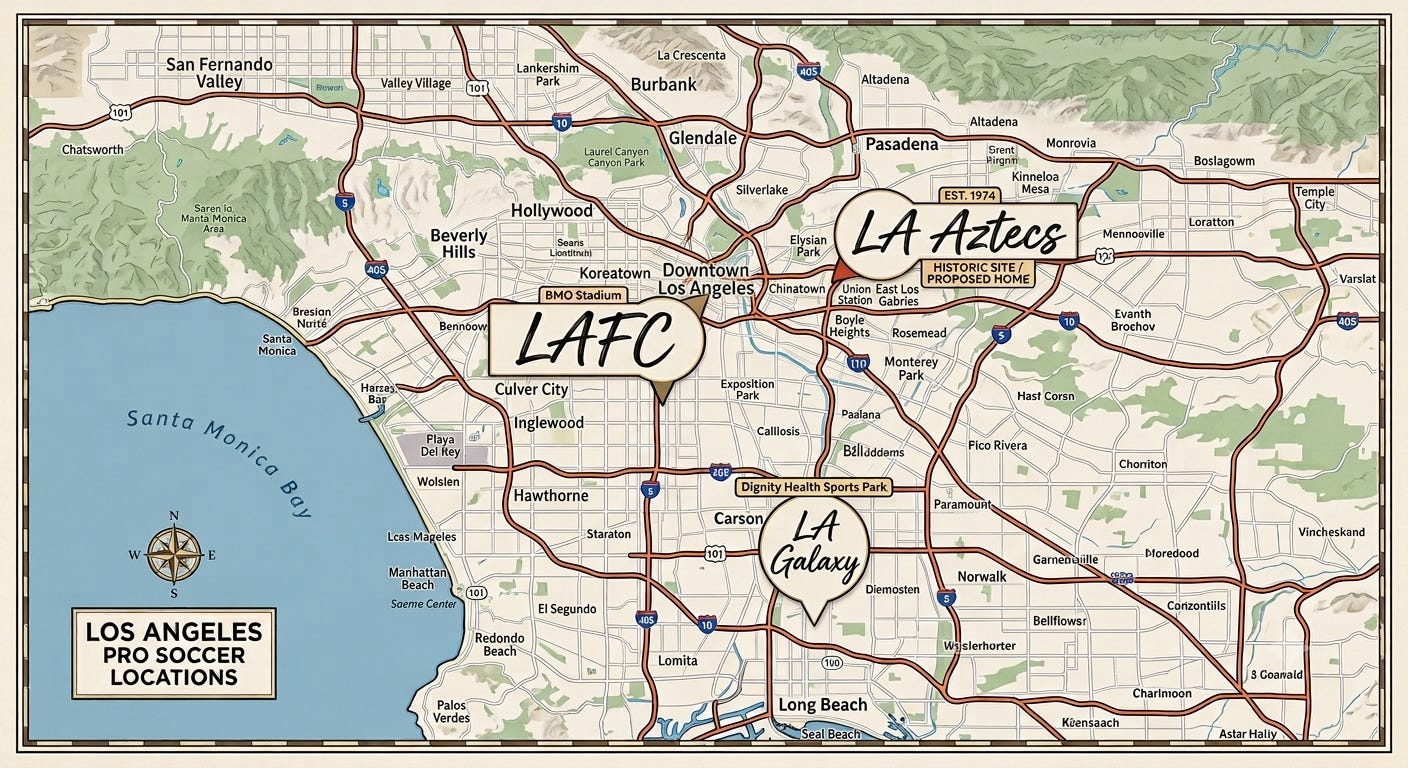
Los Angeles does not need another MLS franchise.
It has Galaxy.
It has LAFC.
Both have trophies. Both have proper supporters. Both have built something substantial.
Good.
Let them.
The Los Angeles Aztecs should come back to build something else.
Not another ownership vehicle with a football team attached.
Not another expensive shirt.
Not another premium experience.
Not another club asking how much more can be extracted from the supporter.
A football club built around the people who follow it.
There is a difference.
And Los Angeles has seen what happens when the difference gets forgotten.
Remember Chivas USA
Chivas USA was supposed to tap into something enormous.
Mexican football culture.
Los Angeles.
One of the world’s most recognisable Mexican club identities.
The ingredients looked obvious.
It failed.
We should be honest about why.
Chivas USA had serious problems long before it disappeared. Ownership, management, results and identity all played their part. MLS did not create every one of those problems.
But MLS did make the final decision.
On October 27, 2014, the league announced that Chivas USA would cease operations immediately. The decision was unanimous among the MLS Board of Governors. In the same announcement, MLS said a new Los Angeles ownership group would be unveiled three days later.
The franchise disappeared.
The football culture did not.
That distinction matters.
Almost Half of Los Angeles County Is Hispanic or Latino
Los Angeles County has about 9.7 million residents.
The latest Census estimate puts the Hispanic or Latino population at 49.3 percent.
Almost one person in two.
Think about what that means for football.
Generations of families with connections to Mexico, Central America and South America.
Liga MX.
National teams.
Local leagues.
Five-a-side.
Sunday football.
Children playing in parks.
Fathers and mothers passing clubs down through families.
Football did not arrive in Los Angeles when MLS arrived.
It was already there.
And that audience should not be treated as a marketing category.
It should not be reduced to Hispanic Heritage Night, translated graphics and a sponsor activation.
That is not community.
That is advertising with better catering.
The Aztecs should do something more difficult.
Go there.
Listen.
Play there.
Scout there.
Hire there.
Invite those communities into the structure of the club itself.
There is an enormous difference between selling football to a community and building a football club with one.
The Aztecs should choose the second.
MLS Has Become Very Good at Business
This is not an argument that MLS has failed.
Commercially, much of the opposite is true.
MLS has grown.
Stadiums have improved.
Investment has increased.
Global players have arrived.
Club valuations have risen enormously.
Sponsors want in.
That is success by one definition.
But there is another side to it.
The supporter gets the invoice.
One 2026 analysis of ticket affordability, using prices gathered from primary and resale ticketing platforms, estimated LAFC tickets at $95, the second-highest figure in MLS.
The same analysis put a beer at BMO Stadium at $16, with estimated concessions of $32.50 before you have considered transport, parking or merchandise.
Then there is the shirt.
An official LAFC 2026 on-field authentic jersey is currently listed at $159.99 on the MLS Store.
LAFC itself advertises season membership partly on the basis that members can receive up to 25 percent off single-match tickets.
None of this is scandalous.
It is business.
That is precisely the point.
MLS has become very good at corporate soccer.
The Aztecs should not try to become slightly cheaper corporate soccer.
They should question the model.
A Family Doesn’t Experience a Valuation
Football executives talk about franchise values.
Supporters experience the bill.
Four tickets.
Parking.
Food.
Two shirts because telling one child they cannot have one tends to damage the matchday atmosphere somewhat.
Suddenly an afternoon watching football has become a significant household purchase.
That matters.
Because football clubs reproduce themselves through children.
A child goes once.
They remember the floodlights.
The noise.
The players.
The shirt.
They ask to go again.
Twenty years later, they take their own child.
That is the real lifetime customer value of football.
Price that child out at the beginning and there is nothing to monetise later.
The Aztecs should understand that better than anyone.
We are trying to rebuild something that disappeared.
Our first job is not maximising revenue per supporter.
It is creating supporters.
Make the Aztecs the Affordable Club
So make affordability part of the identity.
Not a promotion.
Not a Tuesday-night offer when nobody wants the seats.
The identity.
Cheap junior tickets.
Family pricing.
Affordable merchandise.
Community allocations.
Tickets through local schools.
Grassroots partnerships.
First-match programmes for children who have never attended professional football.
Some games where kids get in for almost nothing.
And measure whether they return.
That is how you build fifty years rather than one financial quarter.
If somebody at the Aztecs ever proposes charging a child $160 for a football shirt, there should at least be an uncomfortable silence in the room.
Go Where Los Angeles Already Plays Football
The Aztecs should also reject another assumption.
That a serious football club must spend its entire existence inside one expensive building.
Los Angeles is enormous.
So move.
Take games around Southern California.
Play exhibitions.
Work with communities.
Use smaller venues.
Take the players to the people.
Pasadena.
The Valley.
South Bay.
East Los Angeles.
Orange County.
Go where football already exists.
A travelling Aztecs model does not need to look temporary.
Done properly, it becomes the point.
The Harlem Globetrotters understood something decades ago that modern football occasionally forgets.
If people cannot get to the show, take the show to them.
Football can still be serious while being entertaining.
Those things used to coexist quite happily before consultants got involved.
Don’t Market at Hispanic Los Angeles. Build With It.
This is where the Chivas lesson matters.
Do not assume ethnicity automatically creates loyalty.
It does not.
People can smell manufactured authenticity.
The Aztecs should not tell Latino communities:
This club is for you.
That still puts the club in charge.
Ask instead:
What would make this your club?
Then listen to the answer.
Bring local coaches into the network.
Create pathways for players who cannot afford expensive academy systems.
Work with Latino-owned businesses.
Bring former Mexican, Central American and South American players into events and coaching programmes.
Communicate naturally in Spanish and English.
Put matches where families can reach them.
Keep prices sensible.
Give supporters a genuine route towards ownership and influence.
Not representation manufactured by a marketing department.
Participation.
Let Galaxy Be Galaxy
There is no need to start a war with Galaxy supporters.
There is no need to attack LAFC supporters either.
They love their clubs.
Good.
Football needs that.
Our argument is with the structure, not the people inside the stadium.
Galaxy can be Galaxy.
LAFC can be LAFC.
The Aztecs should not measure success by whether we become more valuable than either.
We probably won’t.
So use another scoreboard.
How many children attended their first game?
How many families came back?
How many local players received opportunities?
How many communities hosted an Aztecs match?
How affordable was the average day out?
How many supporters own part of the club?
How many people who previously had no local team now say:
The Aztecs are mine.
Those numbers interest me far more than a theoretical billion-dollar valuation.
We Already Have What Modern Sport Tries to Manufacture
The Aztecs do not need somebody to invent heritage.
We have it.
The club began in 1974.
It won a championship.
George Best wore the shirt.
Johan Cruyff wore the shirt.
The Aztecs lived, disappeared and survived in people’s memories.
There are scars in the story.
Keep them.
Modern sport spends millions trying to manufacture authenticity.
We already have fifty years of it.
Our job is not to polish it until it looks corporate.
Our job is to bring it back to life.
Build the Alternative
The easy route would be to copy MLS.
Find wealthy investors.
Find a stadium.
Increase prices.
Sell premium seats.
Launch expensive shirts.
Talk about valuations.
Call everybody a stakeholder.
Eventually put a craft cocktail next to the corner flag.
There are already people doing that exceptionally well.
The Aztecs should take the harder road.
Affordable football.
Travelling football.
Football for children.
Football built with Los Angeles’ Hispanic communities rather than marketed at them.
Football where supporters can eventually own meaningful power.
Football that remembers Cruyff and Best but is not trapped in 1979.
Football where investors provide capital without becoming the reason the club exists.
A real Los Angeles football club.
Not because Galaxy and LAFC are failures.
Because they have already proved their model works.
Now somebody should prove another model can work too.
MLS has corporate soccer covered.
Los Angeles does not need a third version of it.
It needs the Los Angeles Aztecs.
Love this mate, and it’s exactly right and as we’ve discussed personally, this is the most realistic model to bring the Aztecs back to life, it has to tap in to people, culture and understand the areas of LA where people live and what they want from a football club, and it has to work for them, serve them, and include them, and it has to be genuine, otherwise it won’t work. This can work, not sure how we do it though without feet on the ground there to do it.