

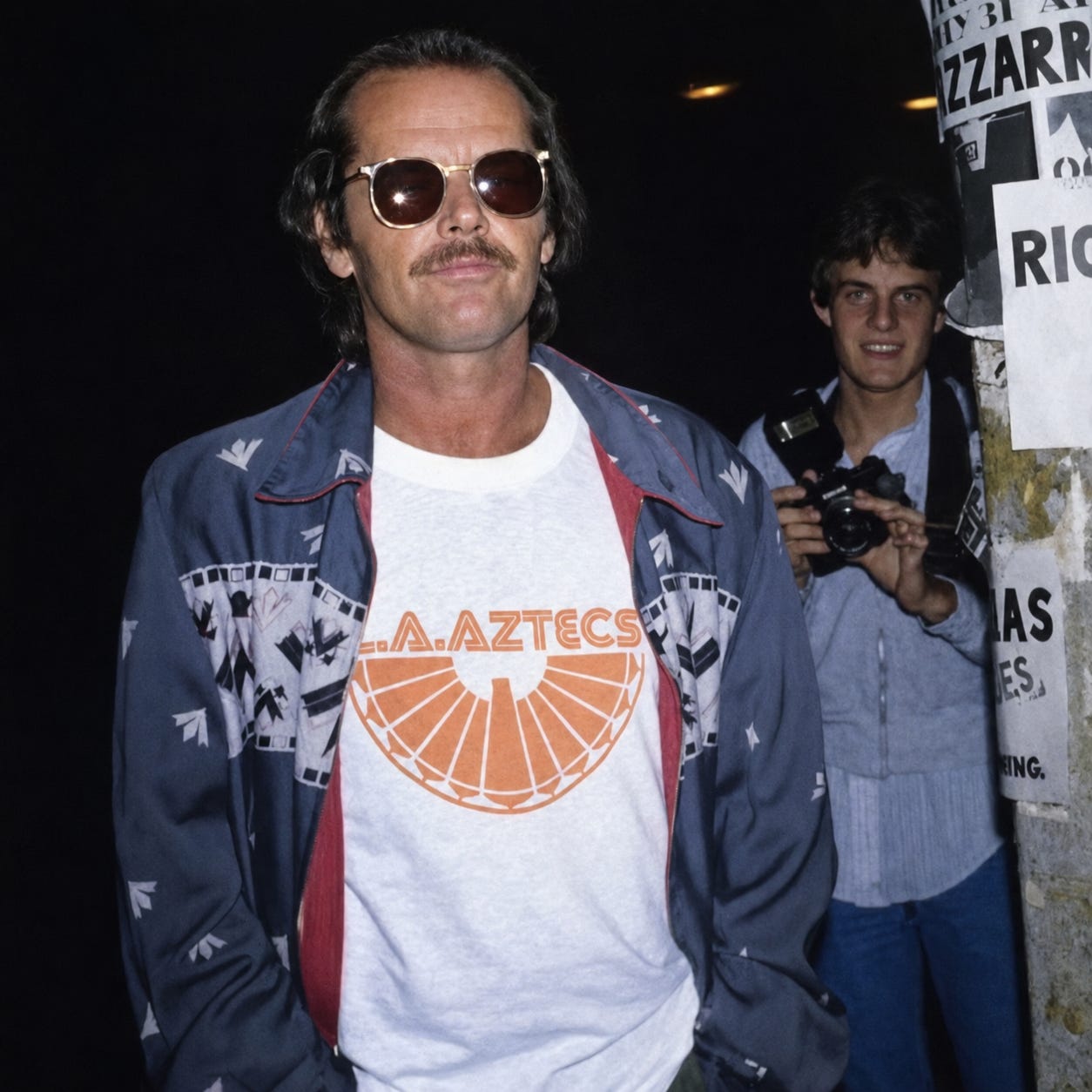
There is a photograph from Los Angeles that I keep coming back to.
Jack Nicholson.
Moustache.
Sunglasses.
Jacket open.
And underneath it, unmistakably, an LA Aztecs shirt.
He is outside The Roxy on Sunset Strip, around 1980.
No influencer campaign.
No celebrity activation.
No gifted merchandise.
No PR agency congratulating itself because a famous person had worn the product.
Just Jack Nicholson wearing the Aztecs.
That is why the photograph matters.
But it also tells only half the story.
Because a football club cannot live forever on Sunset Strip.
It has to reach the streets beyond it.
Jack Became Los Angeles
Nicholson wasn’t born in California.
He came from New Jersey and headed west as a teenager, taking a low-level job at MGM before building one of the greatest acting careers Hollywood has ever seen.
Easy Rider.
Five Easy Pieces.
Chinatown.
One Flew Over the Cuckoo’s Nest.
The Shining.
Batman.
A Few Good Men.
As Good as It Gets.
Twelve Academy Award acting nominations.
Three wins.
But somewhere during that extraordinary career, Nicholson became something bigger than another actor working in Hollywood.
He became part of Los Angeles itself.
The sunglasses.
Mulholland Drive.
The parties.
The Lakers.
The Forum.
The courtside seat.
That grin.
The feeling that Jack might be having considerably more fun than everybody else in the building.
He belonged to the city.
And that is why seeing him in an Aztecs shirt still has power nearly half a century later.
1974: Nicholson, Chinatown and the Aztecs
The timelines almost feel scripted.
In 1974, Nicholson starred as Jake Gittes in Chinatown, one of the great films about Los Angeles.
That same year, the Los Angeles Aztecs played their first NASL season.
And won the championship.
Two very different pieces of Los Angeles culture were emerging at the same moment.
Nicholson represented a Hollywood becoming less polished, more rebellious and more interesting.
The Aztecs represented a football culture doing something similar.
This wasn’t European football neatly transplanted into California.
It became its own strange Los Angeles mixture.
Football.
Entertainment.
International stars.
Music.
Celebrity.
Experimentation.
Then those worlds started colliding.
Elton John Walked In
In 1975, Nicholson appeared in Ken Russell’s Tommy.
So did Elton John.
Later that year, Elton bought into the Los Angeles Aztecs.
Think about that for a second.
Jack Nicholson.
Elton John.
Hollywood.
Rock and roll.
Los Angeles.
Football.
Today somebody would produce a 70-page brand strategy explaining how to create that crossover.
Back then it just happened.
Elton loved football.
Then came George Best.
If you were constructing a player specifically for 1970s Los Angeles, you would struggle to invent someone better.
Brilliant.
Charismatic.
Unpredictable.
Flawed.
Impossible to ignore.
Then Rinus Michels arrived.
Then Johan Cruyff.
The club had become a meeting point for extraordinary characters.
And somewhere inside all of that, Jack Nicholson put on the shirt.
Jack and the Lakers
To understand Nicholson’s place in Los Angeles sport, you have to understand the Lakers.
He became a Lakers season-ticket holder in 1970.
And he stayed.
Decade after decade.
His courtside seat became almost as recognisable as some of the players on the floor.
That matters because Nicholson wasn’t appearing twice a year when a film needed promoting.
He actually cared.
He watched.
He argued.
He celebrated.
He suffered.
He came back.
When Jerry Buss bought the Lakers in 1979, he understood something professional sport still occasionally forgets.
Sport is competition.
But great sport becomes culture.
The Forum wasn’t simply somewhere basketball happened.
It became somewhere Los Angeles wanted to be.
Magic Johnson.
Kareem Abdul-Jabbar.
Pat Riley.
The Laker Girls.
Hollywood courtside.
Jack Nicholson.
None of those ingredients worked alone.
Together they created Showtime.
And Jack wasn’t a brand ambassador.
That was precisely why he was valuable.
A Supporter, Not an Influencer
Nicholson once explained part of his attraction to sport very simply.
He enjoyed watching something when he didn’t know how it would end.
That is football too.
No script.
No second take.
No guarantee.
You pay your money and something happens.
Maybe something extraordinary.
That is the difference between fandom and promotion.
Nicholson wasn’t being paid to act like a Lakers supporter.
He was one.
Eventually his devotion became so famous that the Basketball Hall of Fame recognised him as a SuperFan.
There aren’t many spectators who end up in a Hall of Fame.
Jack managed it without scoring a point.
And It Wasn’t Only Basketball
Basketball was undoubtedly Nicholson’s great sporting obsession.
We shouldn’t rewrite history and pretend he followed every LA franchise with the same intensity.
But he also appeared around the city’s broader sporting culture.
When Wayne Gretzky arrived and transformed the Los Angeles Kings, Nicholson was there too.
Again, the attraction makes sense.
Great players.
Great characters.
A city discovering something.
Sport becoming theatre without ceasing to be sport.
That same possibility existed with the Aztecs.
Jack Nicholson in an LA Aztecs Shirt
We should be careful here.
A photograph does not prove Nicholson was an Aztecs season-ticket holder.
I haven’t found evidence that his relationship with the club came anywhere close to his relationship with the Lakers.
There is no need to invent that.
The truth is good enough.
Around 1980, while the original club still existed, one of the biggest movie stars on earth was photographed on Sunset Strip wearing an LA Aztecs shirt.
By then Nicholson had already made Easy Rider, Chinatown and One Flew Over the Cuckoo’s Nest.
He could wear whatever he wanted.
He chose the Aztecs.
That matters.
Because it tells us the club had travelled beyond the pitch.
The Aztecs Had Entered LA Culture
This is what gets lost when people analyse old clubs purely through attendance figures and league tables.
The Aztecs briefly penetrated Los Angeles culture.
Elton John owned part of them.
George Best played for them.
Rinus Michels coached them.
Johan Cruyff played for them.
Jack Nicholson wore them.
That is an astonishing collection of names for a football club that existed for less than a decade.
Cruyff’s arrival brought another surge of interest.
Crowds increased.
The football improved.
The club became interesting again.
Yet none of it was enough to save the original Aztecs.
And that is where the history becomes more useful than the nostalgia.
Sunset Strip Wasn’t Los Angeles
Here is the mistake we cannot repeat.
The original Aztecs reached Hollywood.
But they never embedded themselves deeply enough in the communities where football was already being played every weekend.
Southern California did not discover football when Johan Cruyff landed at LAX.
It was already there.
In parks.
Schoolyards.
Sunday leagues.
Immigrant communities.
Mexican-American neighbourhoods.
Central American families.
Pickup games.
Local clubs.
Generations of people for whom fútbol required no celebrity endorsement at all.
Long before the NASL arrived, Los Angeles had football culture.
And long after the NASL disappeared, that culture remained.
That is the uncomfortable lesson.
The Aztecs managed to become fashionable without becoming indispensable.
They reached Sunset Strip.
They did not reach deeply enough into the streets.
When the glamour disappeared, there wasn’t enough underneath it to hold the club up.
Hollywood Is Part of Los Angeles. It Isn’t All of Los Angeles.
I love the Nicholson photograph.
We should celebrate it.
The Aztecs should own that history proudly.
But rebuilding this club cannot mean reconstructing a 1970s celebrity scrapbook.
Los Angeles is bigger than Hollywood.
It is Palmdale.
East LA.
The San Fernando Valley.
South LA.
Long Beach.
Santa Ana.
The Antelope Valley.
Working families.
Kids playing football under floodlights.
Sunday leagues nobody in professional football bothers watching.
Communities that understand the game perfectly well without somebody explaining “soccer culture” to them.
That is where a football club has to earn its place.
Hollywood can amplify culture.
It cannot substitute for it.
The Modern Influencer Trap
Professional sport has become very good at imitating authenticity.
A club launches a shirt.
A PR agency identifies twenty influencers.
Boxes are dispatched.
Photos appear.
Everybody pretends something culturally significant has happened.
It hasn’t.
An invoice has happened.
I don’t want that for the Aztecs.
I don’t want us mailing free hoodies to people because somebody has calculated their TikTok engagement rate.
If somebody wears an LA Aztecs shirt outside The Roxy fifty years after Jack Nicholson did, I want it to be because they chose it.
Because they support the club.
Because they grew up nearby.
Because their kid plays in our programme.
Because their mate stands behind the goal.
Because the badge means something.
That is harder.
Good.
Anything worth building usually is.
You Cannot Manufacture Cool
The modern sports industry spends extraordinary amounts of money trying to manufacture the very thing the original Aztecs stumbled into naturally.
Cultural relevance.
Celebrity appearances.
Lifestyle collaborations.
Creator campaigns.
Brand activations.
Launch events.
Mood boards.
Jack Nicholson simply opened his jacket.
There was the badge.
That is infinitely more powerful.
Because genuine culture spreads sideways.
People see something they like.
They join it.
Then somebody else joins.
Eventually the city starts carrying the club without being asked.
The Lakers understood that.
Jack didn’t single-handedly make the Lakers cool.
Magic didn’t.
Jerry Buss didn’t.
Hollywood didn’t.
Los Angeles didn’t.
They reinforced each other.
The team became part of the city.
The city became part of the team.
That is when a franchise becomes a club.
Capital Builds the Stadium. Culture Builds the Club.
This is ultimately why Jack Nicholson’s photograph matters to me.
Not because celebrity is the strategy.
The opposite.
It proves what happens when culture becomes strong enough that famous people want to associate themselves with it without needing to be paid.
That is the Matchmaker philosophy behind rebuilding the Aztecs.
Bring the pieces together.
Investors.
Supporters.
Players.
Developers.
Local government.
Kids.
Coaches.
Businesses.
Communities.
Football people.
Creative people.
The stadium needs capital.
The training ground needs capital.
The district needs capital.
But money cannot build belonging.
You cannot finance culture into existence.
You create the conditions.
Then people build it themselves.
The New Aztecs Have to Finish the Job
The original Aztecs showed what was possible.
They connected football with the imagination of Los Angeles.
That deserves enormous respect.
But the next version has to go further.
Hollywood and the neighbourhoods.
The investors and the supporters.
The stadium and the park pitch.
Cruyff’s legacy and the kid kicking a ball against a wall in the Antelope Valley.
Top-down capital.
Bottom-up culture.
Together.
That is how you build something that survives when the celebrity leaves.
Something that survives when the star player transfers.
Something that survives a bad season.
Something that can still matter fifty years later.
The Photograph Still Matters
Jack Nicholson.
Sunset Strip.
Sunglasses.
Moustache.
LA Aztecs across his chest.
It remains one of my favourite images from the club’s history.
But I see it slightly differently now.
It isn’t proof that we should chase celebrities.
It is proof that we shouldn’t have to.
Build something interesting enough.
Build something authentic enough.
Build something rooted deeply enough in Los Angeles.
And eventually people will choose to carry it for you.
Maybe that person is a kid from Palmdale.
Maybe a barber in East LA.
Maybe a musician.
Maybe an actor.
Maybe the next Jack Nicholson.
It doesn’t really matter.
Capital can build the stadium.
Only people can build the club.
And when you get that right, you don’t manufacture cool.
Los Angeles does it for you.