

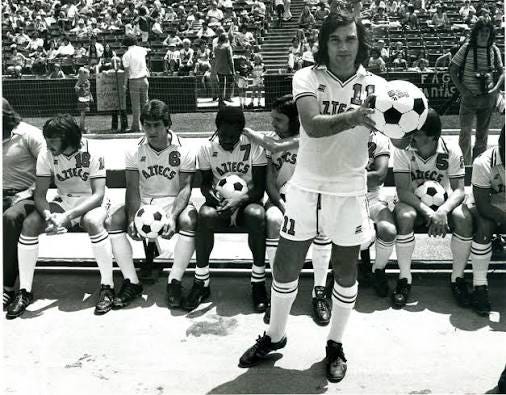
On 20 February 1976, George Best stepped off a plane in Los Angeles wearing a white T-shirt.
Across the front were the words:
WHO THE HELL’S GEORGE?
Los Angeles was about to find out.
Ten days later, the Los Angeles Aztecs presented him at the Memorial Coliseum. Elton John arrived in a Cadillac limousine wearing a mink coat and dark glasses. There was a penalty competition, television cameras and enough theatre to make traditional football men reach for the smelling salts.
Best took it in his stride.
Of course he did.
He had spent half his life being watched.
The Aztecs had not merely signed a footballer.
They had signed George Best.
There is a difference.
Before Los Angeles
By the time Best reached California, he had already lived several football lives.
He had left Belfast as a slight, homesick teenager and become the brightest player at Manchester United.
He won two English league titles.
He won the European Cup in 1968.
He won the Ballon d’Or the same year.
He was brilliant enough to be compared with Pelé and famous enough to be called the Fifth Beatle.
At his peak, Manchester United reportedly received thousands of letters each week addressed to him. He could beat defenders from a standing start, score from impossible angles and turn a match into something closer to jazz than organised sport.
But fame had arrived before anybody understood what it could do to a young footballer.
There was no player-care department.
No carefully managed public profile.
No social-media adviser telling him when to sleep, what to eat and which approved emotion to display after a defeat.
There were newspapers.
Nightclubs.
Money.
Expectation.
And alcohol.
Best left Manchester United in 1974, still only 27. His absences and drinking had damaged the relationship with the club, but the ability had not simply vanished. He was not an old player searching for a ceremonial payday.
He was a genius whose life had moved faster than his career could safely carry him.
Los Angeles offered distance.
Sunshine.
Anonymity, or something resembling it.
And another football pitch.
The West Coast answer to Pelé
The North American Soccer League understood celebrity.
Pelé had joined the New York Cosmos in 1975 and turned a struggling American competition into international news.
The Cosmos had New York.
They had Pelé.
They had the money and machinery of Warner Communications behind them.
Los Angeles needed its own answer.
The Aztecs already had history. They had won the NASL championship in their first season in 1974.
What they did not have was the attention of a city accustomed to stars.
So they went and found two.
Elton John became a part-owner.
George Best became the face of the team.
One ruled popular music.
The other had changed what a footballer could look like, play like and become.
The plan was obvious: Pelé and the Cosmos in the east; Best, Elton and the Aztecs in the west.
Football as sport.
Football as theatre.
Football as Los Angeles.
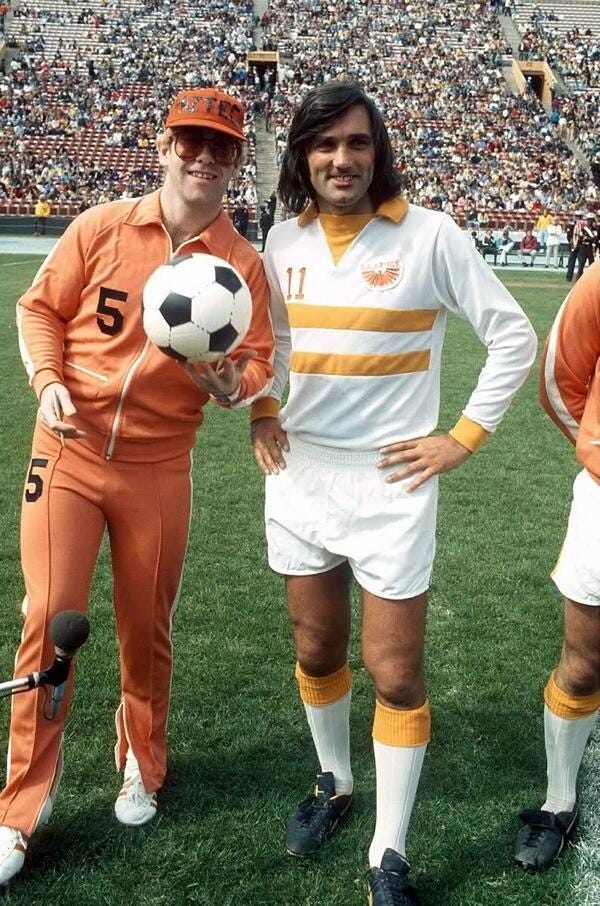
George and Elton
The images remain extraordinary.
Elton in an Aztecs kit.
Best standing nearby.
White boots.
Dark glasses.
One of the biggest musicians alive attempting to kick a football while one of the greatest players alive watches him.
They look less like an owner and an employee than two men who understood the strange territory where talent becomes celebrity.
They became friends, and their public chemistry helped give the Aztecs an identity no advertising agency could have invented.
Elton loved football.
Best lived it.
Both had risen from ordinary British backgrounds into extraordinary international fame. Both knew what it meant to walk into a room and alter its temperature.
Elton was not, however, running training or negotiating every transfer. Contemporary accounts suggest his day-to-day involvement was limited by his music career and commitments to Watford. His greatest immediate value to the Aztecs was symbolic: his name, his presence and his relationship with Best made the club feel connected to a wider cultural world.
That distinction matters.
The story does not need inflating.
Elton John and George Best were already large enough.
Best was still a serious footballer
It is easy to tell the Los Angeles story through sunglasses, limousines and bars.
That would also be lazy.
Best came to play.
In his first Aztecs season, he scored 15 goals in 23 league appearances.
He was no longer the untouchable 22-year-old who had dismantled Benfica at Wembley, but he could still control games that moved at his speed. His balance remained unnatural. His first touch still gave him time other players did not possess.
In 1977, he changed role.
Best recorded 18 assists, tying the NASL record, with many of those chances converted by Steve David, who finished as the league’s leading scorer.
A player remembered as an individualist had become the league’s outstanding supplier.
That is the part casual history often misses.
Best did not only dribble.
He saw football.
He understood weight, angle and timing. He knew when a defender had shifted his balance before the defender knew it himself.
The legs eventually slow.
The picture inside the head does not.
The day Los Angeles beat Pelé
On 3 July 1977, the New York Cosmos came to the Los Angeles Memorial Coliseum.
Pelé was nearing the end.
Best was wearing the Aztecs shirt.
More than 32,000 people attended.
The match offered the rivalry the league wanted: the world’s most famous footballer against the game’s original rock-and-roll star; New York against Los Angeles; the established glamour machine against the restless western alternative.
The Aztecs won 4–1.
It was Pelé’s last competitive appearance in Los Angeles.
For one afternoon, the west coast did not merely compete with the Cosmos.
It beat them properly.
That result belongs in the centre of the Aztecs story.
Not because it changed the balance of American football forever.
It did not.
Because it showed what the club could be when the football, the city and the occasion aligned.
A great name.
A great stage.
A crowd given something worth remembering.
Bestie’s in Hermosa Beach
Best’s relationship with Los Angeles did not end at the touchline.
He moved toward the South Bay and opened Bestie’s Bar and Restaurant in Hermosa Beach.
The bar became a gathering place for British expatriates, football people, locals and visitors who wanted to be close to the mythology.
Best was not hidden in a private members’ club behind velvet ropes.
He was there.
At the bar.
Talking football.
Living the life that had made him magnetic and was also slowly destroying him.
The venue later became the Underground Pub and Grill, but the connection remained. Photographs and memorabilia kept Best’s story inside the building, and the old bar continued to attract football supporters decades after his Aztecs career ended.
There is something very George Best about choosing Hermosa Beach.
Not Hollywood behind a gate.
Not Beverly Hills beneath a chandelier.
A beach town.
A bar.
Football on the television.
People coming and going.
The Pacific outside.
Best reportedly said that Southern California reminded him of Marbella, another place where he had found temporary relief from the British press.
Los Angeles gave him space.
The cruel irony is that it also gave his appetites space.
The city offered escape.
It could not offer rescue.
Los Angeles became personal
Best’s American years changed more than his football career.
He met Angela MacDonald-Janes while playing for the Aztecs. They married in Las Vegas in 1978, and their son, Calum, was born in 1981.
That made California part of his family story, not merely another pin on a map of clubs.
The connection endured.
Calum later returned to Bestie’s and publicly remembered the Hermosa Beach establishment that had once carried his father’s name.
For George, Los Angeles became football, friendship, business, marriage and fatherhood.
A fresh start that was never completely fresh.
A home that was never completely home.
The decline
A proper tribute cannot turn a man’s destruction into decoration.
By 1978, the warning signs had become harder to ignore.
Best missed training.
His drinking worsened.
The Aztecs suspended him without pay, and he was eventually moved to the Fort Lauderdale Strikers.
The city that had offered freedom had also made it easier for him to disappear into the night.
That was not Los Angeles’ fault.
It was not football’s fault alone.
It was the reality of addiction, fame and a man who could beat almost anyone placed in front of him except the opponent travelling inside him.
We should resist the temptation to make that decline charming.
It was not charming.
It cost Best years of football.
It hurt people around him.
It eventually cost him his life.
The drinking stories have often been polished into punchlines because the man telling them was handsome and funny.
Behind the lines was illness.
Behind the mythology was pain.
The respectful thing is not to erase either side.
Remember the genius.
Tell the truth about the damage.
His American masterpiece came later
Best left Los Angeles, but he did not leave American soccer.
He played for Fort Lauderdale and later San Jose.
In 1981, wearing the colours of the San Jose Earthquakes against his former Fort Lauderdale side, he scored the goal many regard as the finest in NASL history.
He moved through a crowd of defenders, changing direction, protecting the ball and refusing to surrender it until the goal finally opened.
It was not scored for the Aztecs.
That should be stated clearly.
But the goal proved something the Aztecs had already witnessed.
George Best’s genius had not been left behind in Manchester.
It crossed the Atlantic with him.
What Best gave the Aztecs
George Best gave the Los Angeles Aztecs credibility.
Not corporate credibility.
Football credibility.
He told the world that this young American club was willing to think beyond the expected limits of American soccer.
He gave supporters a reason to look.
He gave defenders a reason to worry.
He gave photographers a reason to keep their cameras ready.
More than anything, he gave the club a character.
That matters because football clubs are not built from logos alone.
They are built from the people who pass through them.
The moments they leave behind.
The stories supporters continue telling when the scoreboard has been taken down and the stadium lights are gone.
Best’s Los Angeles chapter was imperfect.
So was Best.
That is why the story lasts.
Perfect people make poor folklore.
What the Aztecs gave Best
The Aztecs gave him another chance to be a footballer.
Not a former footballer.
Not a celebrity opening a nightclub.
Not a damaged Manchester United memory.
A footballer.
He scored.
He created.
He entertained.
He played in front of more than 32,000 people as Los Angeles beat Pelé’s Cosmos.
For a time, the ball was at his feet again and the world made sense.
Perhaps that was the greatest gift the Aztecs gave him.
One more stage.
One more shirt.
One more city willing to believe.
Why his story matters now
We are not rebuilding the Los Angeles Aztecs to trade endlessly on the names of men who are no longer here.
George Best deserves better than becoming decoration on a sales deck.
His story gives us a standard.
Football should have personality.
Players should be allowed to create.
Clubs should produce memories bigger than their corporate language.
But the story also carries a warning.
Ambition without structure eventually collapses.
Celebrity cannot replace governance.
A great player cannot repair an unstable institution by himself.
The original Aztecs reached for the stars.
The revived Aztecs must keep that courage while building stronger foundations beneath it.
Keep the imagination.
Lose the chaos.
Keep the personality.
Build the institution.
That is how history becomes useful.
The Matchmaker’s word
George Best did not arrive in Los Angeles as a saint.
He did not leave as one.
He was something more interesting.
Human.
Brilliant.
Damaged.
Generous.
Unreliable.
Funny.
Unrepeatable.
He made mistakes in public and magic in front of thousands.
Los Angeles did not cure him.
But for a while, it gave him sunlight, friendship and football.
Elton brought the music.
Best brought the soul.
The Aztecs gave them a badge beneath which both worlds could meet.
We cannot bring George back.
We can build a club worthy of the stories he left behind.
The Los Angeles Aztecs campaign is now on Wefunder, where supporters can examine the proposal, read the current terms and decide whether they want to become part of the next chapter. The project is currently testing investor interest, with a first event targeted for 2027.
Explore the Los Angeles Aztecs on Wefunder
George Best gave the Aztecs a past people still talk about.
Now we have to build a future worth talking about.
This article is for general information only and is not investment advice or an offer to sell securities. Early-stage investments are speculative, illiquid and may result in the total loss of the money invested. Review the official Wefunder materials before making any decision.