

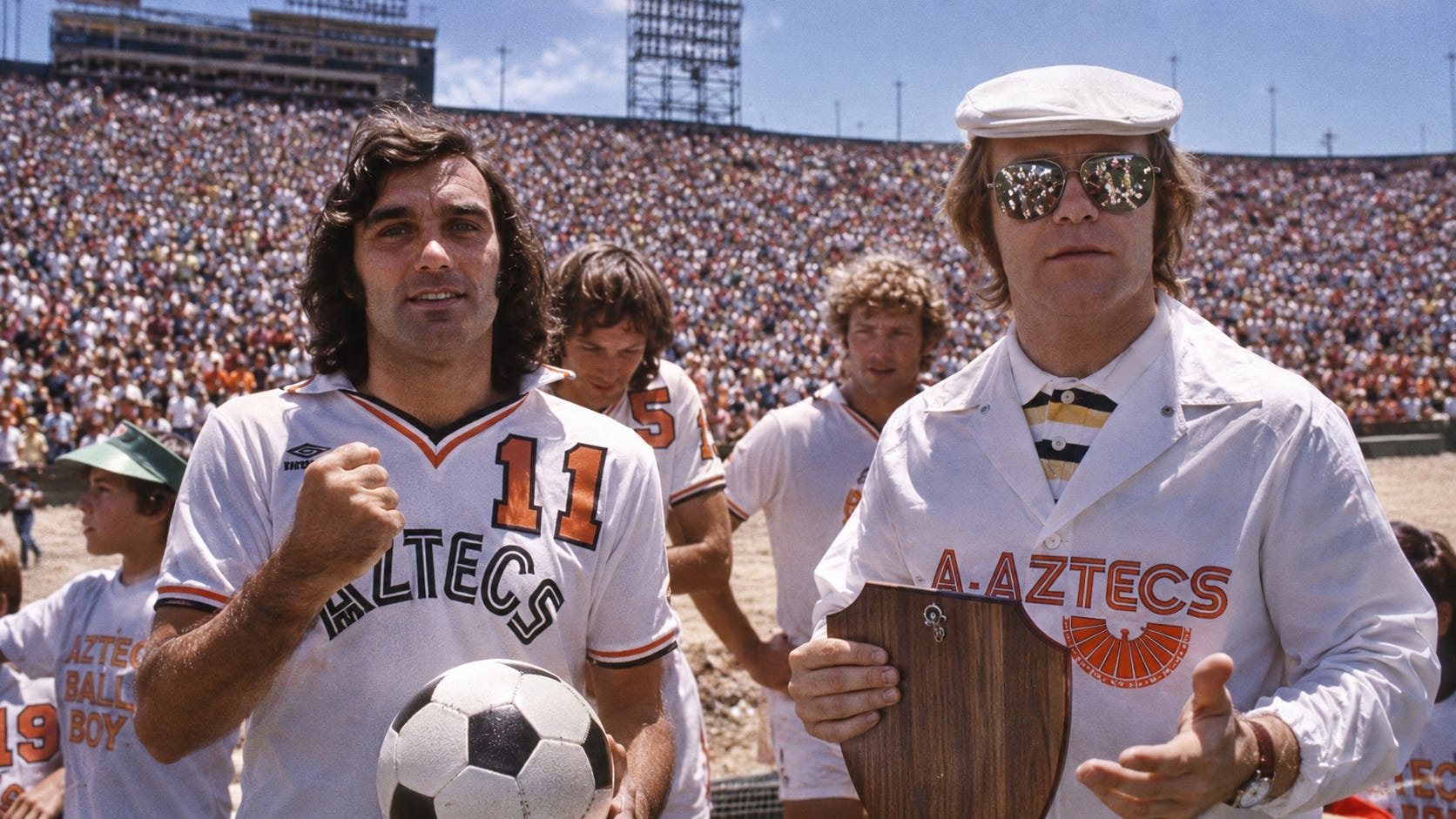
Football Abandoned the Aztecs. I Didn’t.
George Best played for them.
Johan Cruyff played for them.
Rinus Michels managed them.
Elton John helped own them.
Then the Los Angeles Aztecs disappeared.
An extraordinary piece of football history was left behind while businessmen elsewhere began charging hundreds of millions of dollars for the privilege of establishing football clubs with no history at all.
I saw the absurdity in that.
More importantly, I saw the opportunity.
The Los Angeles Aztecs were American soccer champions in 1974. They won the championship in their first season. Before Best arrived. Before Cruyff. Before the great Dutch experiment that would eventually become one of the most fascinating chapters in American sporting history.
This was not a marketing department’s invention. It was a football club with a beating heart.
It existed in a city that understood entertainment better than almost anywhere on earth.
Football met Hollywood. European genius met American ambition. Music met sport. And for a brief period, Los Angeles became home to some of the most extraordinary football personalities the world had ever produced.
On Independence Day in 1980, more than 48,000 people gathered at the Rose Bowl to watch the Aztecs play Washington Diplomats. The occasion included a fireworks attraction and the return of Cruyff as an opposing player.
It was not an ordinary league attendance. It was an event.
There is a lesson in that distinction.
Then, after the 1981 season, the club disappeared.
The football stopped. The players moved on. The business failed to survive. The shirts became collectors’ items. The photographs became memories.
The name remained part of football history, but nobody had established a sustainable modern business around it.
The Harlem Globetrotters of football. But with real football. Real opponents, genuine competition and results decided on the pitch. I call the business Heritage Sports Entertainment: an authentic sporting identity brought back to life through competitive football, touring events, media and commercial rights.
For more than four years, I have worked to recover the identity through trademark applications, legal complications and negotiations. Everybody wants to attend opening night. Few want to build the stage. I understand why: investors have responsibilities, and belief alone does not pay the bills. But I did not spend those years fighting for a name simply to buy admission to somebody else’s league. I want to build a business that earns its own audience. This is how.
The Boy Who Never Asked Permission
I left school at fifteen.
There was no university education waiting for me. No established career path. No investment banker explaining how to structure my first business.
I came from Lancashire.
I learned to cut hair. I learned to deal with customers. I learned that people will return if you give them something worth returning for.
It was a straightforward education in business.
The customer arrived.
You did the work.
You received payment.
If you were no good, the customer went somewhere else.
There was nobody to blame. No committee to hide behind. No complicated presentation explaining why the business had failed to generate revenue.
That experience stayed with me.
I eventually founded Hairbond, developing a British professional hair styling brand in an industry dominated by much larger businesses.
I learned about manufacturing, distribution, branding, intellectual property, international sales and the difficult difference between getting a product into the marketplace and getting somebody to buy it.
I became involved in reviving Stylo Matchmakers, a historic British sporting brand associated with some of the greatest names in football.
Again, the opportunity interested me because the history was extraordinary and the modern commercial potential had not been fully realised.
I worked inside football as an intermediary.
I dealt with footballers, clubs, executives and people who controlled opportunities that could change somebody else’s career.
I saw the good side of football.
I saw people who genuinely cared about players and supporters.
I also saw how a game that belonged to working people had developed increasingly expensive barriers between those who loved it and those who controlled it.
Football could be a magnificent business.
It could also be an extraordinarily closed shop.
Your ability to influence the game did not always depend on the quality of your ideas.
Sometimes it depended on who knew you.
Sometimes it depended on who had introduced you.
Sometimes it depended on whether your presence was convenient for somebody already making money.
That never sat comfortably with me.
I have always been more interested in what somebody can do than in whether they possess the correct background.
The footballer who was released at eighteen might become a better player at twenty-three.
The entrepreneur without a university degree might have a better commercial instinct than somebody with three qualifications.
The former footballer without a job in the game might have more to offer than the executive currently employed to develop football strategy.
The world is full of people whose value has been underestimated.
It is also full of people whose value has been exaggerated by their position.
I have made a career out of looking for the difference.
That is why I call myself the Matchmaker.
I connect people, opportunities and ideas.
I look for things that make more sense together than they do independently.
The Aztecs are the largest expression of that philosophy.
Here is a sporting identity with authentic history.
Here are former footballers who still possess talent, recognition and commercial appeal.
Here are local players who deserve opportunities.
Here is a global entertainment industry searching for valuable new content and experiences.
Here are investors increasingly interested in emerging sports properties.
Here are supporters tired of being treated as a captive market.
Why should those things not be brought together?
Why must the answer always be another conventional football club?
Why must the person with the idea wait for permission from the person who controls the existing system?
I have spent enough of my life listening to people explain what cannot be done.
Some of them have offered valuable advice. Others have merely defended the arrangements from which they benefit.
You learn to recognise the difference.
I do not possess every skill required to build the Los Angeles Aztecs.
I have no intention of pretending otherwise.
But I possess the ability to recognise the opportunity, articulate the vision and bring together people capable of delivering it.
That is the role of a founder.
That is the role of a promoter.
And that is where my contribution to the Aztecs begins.
The Football Industry Has Lost Its Nerve
Modern football is technically extraordinary.
The players are fitter. The pitches are better. The infrastructure is more sophisticated. The commercial revenues are greater than anything previous generations could have imagined.
There are analysts examining every movement.
Recruitment departments evaluating vast amounts of information.
Coaches discussing tactical structures with a complexity that would have sounded like engineering to many supporters thirty years ago.
There is nothing wrong with progress.
But I sometimes wonder whether football has become so sophisticated that it has started to forget what made it magnificent.
The player who takes risks is told to manage the risk.
The winger who attempts something outrageous is reminded about possession.
The goalkeeper is expected to understand several different tactical systems, while the supporter wonders why nobody has had a shot.
The footballer gives an interview.
He respects the opposition.
He is focused on the next game.
The team will take things one match at a time.
Everybody has apparently received the same script.
This is an industry containing extraordinary human beings with extraordinary experiences, yet it often presents them to the public as though individuality represents a commercial liability.
George Best did not become George Best because he always made the safest decision.
Johan Cruyff did not change football by accepting that the game could not be played differently.
The great footballers challenged assumptions.
They saw things that other people could not see.
They attempted things that other people would not attempt.
Their individuality was part of their value.
Football must never become a game in which the most interesting thing a player can do is follow instructions.
The business surrounding football has developed a similar problem.
The institutions have become comfortable.
The established competitions have become valuable.
The people who control access to those competitions have discovered that restricting access can help protect that value.
Supporters are expected to accept higher prices.
New ownership groups are expected to arrive with larger sums of money.
Smaller clubs are expected to find increasingly wealthy benefactors.
The conversation becomes less about who can build the best football organisation and more about who can afford to enter the room.
That may be a rational commercial system for the people who already own it.
It is not necessarily the system I want to join.
I have no objection to successful businesses making money.
I am building a business myself.
I want the Aztecs to become profitable.
My objection is to the assumption that football’s commercial development must inevitably concentrate opportunity in fewer hands.
There should be room for alternative models.
There should be room for independent entrepreneurs.
There should be room for footballers whose careers did not follow the established route.
There should be room for supporters who cannot afford expensive hospitality packages.
There should be room for innovation on the pitch, not merely innovation in the way money is extracted from the people watching it.
The most interesting sporting businesses are not always the ones with the largest existing infrastructure.
Sometimes they are the ones willing to question what a sporting experience could become.
The Aztecs will not spend their existence complaining about the football establishment.
Complaining does not produce football matches.
We will attempt to demonstrate that another approach is possible.
The best criticism of a bad business model is a better business model.
The best response to being excluded from a system is building something people want to be part of.
I want the Aztecs to become that something.
The Millions That Football Left Behind
The original Los Angeles Aztecs were not a small historical curiosity.
They were a serious commercial undertaking involving significant investment, internationally recognised footballers and substantial ambition.
The financial history makes uncomfortable reading.
Money was spent on players, operations, ownership transactions and attempts to establish professional soccer in a difficult American marketplace.
In 1980, Washington Diplomats acquired Johan Cruyff from the Aztecs for a reported $1 million.
That same year, Mexican television company Televisa purchased the Los Angeles club for more than $1 million.
These were substantial transactions for their time.
They demonstrate that the Aztecs were once considered commercially important enough to attract serious financial commitments.
But the existence of those transactions did not guarantee survival.
The underlying business needed sustainable income.
It needed an audience that returned regularly.
It needed a cost structure that reflected the realities of the market.
The original owners could secure famous names. They could generate attention. They could produce extraordinary occasions.
What they could not establish was a business sufficiently durable to survive.
That matters to me.
I am interested in the history, but I am more interested in understanding it.
It would be easy to publish old photographs, talk about the greatness of the original club and suggest that bringing back the badge automatically brings back its value.
It does not.
The millions spent on the original Aztecs cannot simply be added together and presented as the current value of the intellectual property.
Some historical figures represent costs. Others represent transfers between owners. Others represent revenue. Some may overlap.
Money once spent does not become money available today.
But the historical investment created something.
Recognition.
Memory.
Cultural significance.
A relationship with some of football’s greatest personalities.
A story that an invented sporting brand would have to spend years attempting to establish.
That is the asset I found interesting.
The world of intellectual property is full of examples of valuable identities that have been neglected, misunderstood or left commercially inactive.
Sometimes the people who created them no longer possess the resources to develop them.
Sometimes the companies that acquired them have different priorities.
Sometimes the market changes and something that previously struggled becomes relevant again.
The opportunity is not necessarily to reproduce the original business.
It is to understand which elements retain value and which elements need to change.
The original Aztecs had football history, entertainment connections and international personalities.
The modern entertainment economy provides opportunities that did not exist in the same form during the 1970s.
Direct-to-consumer media.
Global digital distribution.
Online merchandise sales.
International communities connected through technology.
Commercial relationships built around individual sporting personalities.
Touring experiences that can establish relationships with audiences beyond one geographical market.
We have the opportunity to combine historical identity with contemporary distribution.
That is very different from attempting to recreate the original club exactly as it existed.
I do not want to repeat its financial mistakes.
I want to use its greatest strengths.
We must also be precise about our legal rights.
Trademark protection has a defined territorial and commercial scope. Historical photographs, archival footage and player likenesses may involve separate rights.
The revival does not automatically give us ownership of everything associated with the original club.
Nor does historical association establish present-day endorsement.
The relevant registrations, applications, challenges, licences and ownership arrangements must be properly verified.
I have spent years working on this foundation because intellectual property matters.
But intellectual property is not an operating business.
A registration certificate cannot score a goal.
A trademark cannot sell out a stadium.
A historic badge cannot negotiate a sponsorship agreement.
People do those things.
The rights create the opportunity.
Execution creates the value.
We have recovered an opportunity that deserves to be developed.
Now we must make it commercially alive.
Why I Refuse to Buy Admission
Major League Soccer has created something commercially significant.
It has established valuable franchises, developed infrastructure, attracted international talent and helped increase the visibility of football across North America.
Its investors have benefited from a model built around controlled expansion, central commercial arrangements and the scarcity of membership.
I understand the attraction.
In 2023, the ownership group behind San Diego’s MLS expansion reportedly agreed to a $500 million entry fee.
That is before considering many of the additional costs associated with operating and developing a major sporting organisation.
Half a billion dollars.
For admission to the system.
The existing franchise owners may consider that evidence of the model’s success.
An entrepreneur standing outside the system might see something different.
He might ask how much sporting entertainment could be created with that capital if it were invested directly into building a business.
How many footballers could be employed?
How many events could be produced?
How many communities could be reached?
How much original content could be developed?
How much valuable commercial infrastructure could be established?
How many mistakes could a business afford to learn from before committing itself to an enormous fixed-cost model?
These are different investment propositions.
An MLS franchise acquires access to an established commercial system. That access has genuine value.
An independent entertainment property must create much more of its commercial value from the ground up.
It has greater uncertainty.
It may lack the protections that institutional investors appreciate about established leagues.
But it can also retain greater flexibility.
It does not necessarily need a permanent stadium.
It does not need to organise its entire commercial existence around an established league calendar.
It can explore different markets.
It can develop its own sporting product.
It can negotiate with promoters.
It can build media around its personalities.
It can test ideas before committing substantial capital.
The Aztecs do not need to defeat MLS.
We do not need MLS to fail.
We do not need supporters to abandon their existing clubs.
People can follow LAFC or LA Galaxy and still want to attend an Aztecs event.
A football supporter can enjoy a conventional league match on Saturday and an alternative football entertainment experience on another occasion.
The market is not necessarily a battle in which one organisation must disappear for another to exist.
Our competition extends beyond football.
We are competing for people’s leisure time.
For their entertainment spending.
For their attention.
For the decision a family makes when considering what to do at the weekend.
That means our product has to be worth attending.
Not merely because we possess a historic identity.
Not because an established authority considers us legitimate.
Because the experience is good.
I have considered conventional professional league pathways. I have examined stadium opportunities and spoken with people about potential infrastructure.
Those options may become relevant in the future.
But they are not the immediate priority.
A business should establish demand before accepting unnecessary fixed costs.
A football club should have people who want to watch it before constructing an expensive place for those people to sit.
We need to understand whether we can sell the product.
We need to establish what the product costs.
We need to understand whether the customer returns.
The order matters.
I am not interested in buying the appearance of progress.
I am interested in creating progress.
The first victory for the Aztecs will not be getting our name accepted by somebody else’s committee.
It will be putting our footballers on a pitch in front of people who have paid because they want to watch them.
That is where football begins.
The Birth of Heritage Sports Entertainment
I believe there is an opportunity to develop a distinctive category of sporting business.
I call it heritage sports entertainment.
It brings together authentic sporting history, contemporary live entertainment, competitive sport, recognised personalities and commercially adaptable intellectual property.
The heritage provides meaning.
The sporting product provides credibility.
The personalities provide recognition.
The entertainment creates an experience.
The commercial organisation connects those elements and turns them into a business.
We are not starting from the same position as an invented football league.
We are not starting from the same position as an established franchise.
We are not simply producing a television programme involving footballers.
We are attempting to reactivate an authentic sporting identity and give it a modern operating model.
That creates a different set of opportunities.
The Aztecs can play football.
They can tour.
They can develop content.
They can establish merchandise collections.
They can create commercial appearances.
They can develop local sporting programmes.
They can work with promoters, media companies and talent businesses.
The same identity can support several related commercial activities without requiring every customer to attend the same stadium.
Consider the difference between a football club selling a match and a sporting entertainment property selling an experience built around a recognisable identity.
The first may be heavily dependent on the fixture list.
The second has the opportunity to develop commercial relationships throughout the year.
A former footballer can participate in an appearance.
A promoter can organise an event.
A broadcaster can distribute content.
A clothing company can develop a licensed collection.
A sponsor can engage with the audience across several markets.
A supporter can become part of the identity without living within travelling distance of Los Angeles.
This does not mean the business can generate all those revenues immediately.
It means the structure creates potential opportunities.
They must be developed in the right order.
The football creates the identity.
The identity creates attention.
The attention creates commercial opportunities.
The commercial opportunities help fund more football.
That is the cycle we need to establish.
There is another advantage.
A historic sporting identity can connect generations.
The person who remembers George Best might introduce the Aztecs to somebody who never saw him play.
A young supporter might discover Cruyff through the history of the club.
A local footballer might understand that he is wearing a shirt associated with one of the most influential sporting philosophies in history.
But this cannot become a museum.
The new generation needs its own memories.
Its own players.
Its own personalities.
Its own moments that become part of the story.
There is no point spending every matchday reminding people how interesting the club was fifty years ago if we cannot give them something interesting to watch today.
Heritage must be used as an advantage, not an excuse.
We intend to establish an identity people can experience in the present.
If we succeed, the Aztecs will not merely represent a famous football club that once existed.
They will represent a distinctive approach to football entertainment.
That is a category worth attempting to build.
The Harlem Globetrotters of Football
The Harlem Globetrotters understood the value of taking a recognisable sporting experience directly to the audience.
They developed an identity capable of travelling.
The audience did not need to understand the complexities of a particular league table to appreciate the occasion.
People understood what the name represented.
It represented basketball, personalities, entertainment and an experience that could be taken to different communities.
That is the commercial inspiration for the Los Angeles Aztecs.
I want people to understand what an Aztecs event represents whether it is taking place in Los Angeles, London, Barcelona, Mexico City or Buenos Aires.
I want promoters to understand the product.
I want sponsors to understand the audience.
I want footballers to understand the opportunity.
And I want the public to recognise the identity.
The difference is fundamental.
Our football will be competitive.
We are not looking to recreate the Globetrotters’ particular exhibition format.
We are building genuine competitive matches around an entertainment experience.
If the opposition is better, it can beat us.
If the young local footballer is better than the international legend on the day, he deserves to demonstrate it.
The goalkeeper is not there to allow a spectacular goal.
He is there to prevent one.
There is no greater sporting entertainment than watching something happen that nobody expected.
The remarkable save.
The outrageous piece of skill.
The unknown footballer who suddenly becomes the most important person in the stadium.
You cannot manufacture those moments through a script without removing the very thing that makes them powerful.
Uncertainty.
That is the central asset of sport.
The promoter can build anticipation. The players can express their personalities. The production can capture the atmosphere. The audience can develop emotional attachments.
But the sporting outcome must remain beyond the control of the entertainment business.
The Aztecs should be capable of touring against interesting opponents.
Former professionals.
Independent teams.
Community-led sporting identities.
Existing clubs where commercial and sporting arrangements permit.
Teams representing different football cultures.
Imagine developing a touring series built around the idea of LA Aztecs versus Everybody.
The opposition changes.
The market changes.
The stories change.
The Aztecs remain identifiable.
There are potentially interesting opportunities within Southern California itself.
Communities across Los Angeles, Orange County, Riverside, Ontario and Rancho Cucamonga have different sporting identities and relationships with football.
We can explore partnerships with local organisations rather than treating every community simply as another market in which to sell tickets.
There may also be opportunities to develop events involving teams inspired by international capital cities.
A London identity.
A Mexico City identity.
A Madrid identity.
A Buenos Aires identity.
Those concepts should emerge through genuine local participation, not through a marketing company inventing a community and then asking the community to purchase it.
The opportunities are extensive.
But we must resist the temptation to build the entire ecosystem before we have established the central product.
First, establish the Aztecs.
Then establish the experience.
Then discover which markets genuinely want it.
The attraction of touring is commercial flexibility.
We can use suitable existing venues.
We can work with local promoters.
We can test different markets without acquiring permanent infrastructure.
We can examine which opponents, football personalities and promotional approaches create demand.
A successful event creates evidence for the next.
An unsuccessful event creates knowledge about what needs to change.
The business improves because it operates.
Not because it commissions another report.
I want the Aztecs to travel.
But before we travel the world, we need to establish something the world wants to see.
Total Football. American Rules.
The Los Angeles Aztecs have one of the most authentic historical connections to Total Football imaginable.
Rinus Michels and Johan Cruyff helped transform the way the game was understood.
Their football was based on intelligence, movement, technical ability and collective responsibility.
Positions were not prisons.
Players could interchange.
Space could be created.
The team could impose its understanding of the game on the opposition.
It was sophisticated football that still allowed individuality.
That is the identity I want to recover.
I want central defenders capable of playing football.
Midfielders capable of seeing opportunities before they become obvious.
Wingers capable of beating opponents.
Forwards who understand movement.
Goalkeepers who participate intelligently in the team’s football.
I want players selected because of their technical ability and their understanding of the game.
Not simply because they satisfy a fashionable recruitment profile.
The football staff must own tactics and selection.
The promoter must not dictate the starting team.
A sponsor must not be able to buy a place in the side for somebody who cannot play.
Football credibility is commercially valuable.
We will protect it.
But there is another part of the Aztecs’ history that interests me.
America once had the nerve to experiment with football.
The original North American Soccer League explored ideas that challenged established European thinking.
The countdown clock.
The 35-yard offside line.
The breakaway shootout.
Some of these experiments became controversial. Some were eventually abandoned. Early Major League Soccer retained the countdown clock and the distinctive shootout before moving towards the conventional international rules.
I believe several of those ideas deserve examination again.
Not because everything American football tried was automatically better.
Because innovation should be examined on its merits.
The 35-yard offside line could provide an interesting opportunity to alter the balance between attack and defence.
Under the historical approach, the offside restriction applied within the designated area near the opposing goal rather than throughout the attacking half.
Could that create more room for technical attacking players?
Could it encourage different patterns of movement?
Could it make defensive positioning more difficult?
Could it produce undesirable consequences, such as teams defending too deep?
We need footballers to test it.
We need coaches to examine it.
We need officials to understand it.
We need evidence.
The countdown clock is another opportunity.
I want supporters to understand how much time remains.
A visible clock with clearly defined stoppage procedures could create a more transparent and dramatic finish.
When the game approaches its conclusion, everybody should understand the urgency.
The referee must retain appropriate authority. The timing system must protect the integrity and safety of the competition.
We should test the balance between effective playing time and the total duration of the event.
Then there is the breakaway shootout.
An attacker starts 35 yards from goal.
He has five seconds to beat the goalkeeper.
He can dribble.
He can shoot.
He can attempt to deceive his opponent.
The goalkeeper has the opportunity to advance and respond.
It is football reduced to one of its most dramatic encounters.
A player.
A goalkeeper.
A ball.
A decision.
I want every independently controlled Aztecs match to have the possibility of a decisive outcome, with the historical breakaway shootout among the ideas we intend to explore.
Imagine the young Maverick walking towards the starting line.
Imagine the crowd understanding exactly what is about to happen.
Imagine the possibility that the unknown player becomes the hero.
There is no need for manufactured drama.
The football creates it.
I also want to investigate larger goals.
The conventional full-size goal measures 24 feet by eight feet.
A proposed experimental goal of 27 feet by nine feet would increase the opening by approximately 26.6 per cent.
That does not mean scoring would increase by the same percentage.
Football does not work like that.
The question is whether a change in the dimensions could encourage more attacking opportunities, different shooting decisions and an improved balance between defence and attack.
It could also produce problems.
Goalkeeping would change. Defensive tactics would adapt. We might discover that the alteration damages the technical qualities we want to preserve.
That is precisely why it should be tested.
Rolling substitutions, carefully designed kick-in rules and temporary dismissals are other ideas worth examining in appropriate formats.
Nothing should be introduced merely because it looks interesting in a presentation.
We need controlled sporting trials, player feedback, medical advice and suitable insurance.
We need to measure the effective playing time, quality of chances, goals, injuries, disciplinary incidents and supporter response.
We should abandon anything that makes the football worse.
Independence does not give us permission to disregard applicable regulations, safety requirements or contractual obligations.
Nor will we impose our experimental rules on another organisation’s competition.
If we enter The Soccer Tournament, we will play under its rules.
Our American Rules concept is intended for events where the necessary control, permissions and protections are available.
We are not trying to destroy the game.
We are trying to rediscover its sense of adventure.
Football has spent enough time examining the position of somebody’s shoulder.
I would rather examine whether we can give the winger a reason to attack the full-back.
Let the footballers play.
Let the coaches think.
Let the supporters enjoy themselves.
Total Football.
American Rules.
That is the ambition.
Global Legends. Local Mavericks.
Football has an extraordinary ability to discard people.
A young player is assessed.
He is measured.
He is categorised.
Somebody decides whether he belongs in the system.
Sometimes that decision is correct.
Sometimes it is not.
A footballer can be rejected because he develops later than the people around him.
Because he is considered too small.
Because he does not fit a particular tactical approach.
Because the club already has somebody in his position.
Because the person making the decision does not recognise what he possesses.
The rejection can follow him.
Opportunities become more difficult to obtain.
The reputation established by somebody else’s decision becomes more important than the footballer standing in front of you.
I have never believed that the football establishment possesses a monopoly on recognising talent.
There are gifted players outside the professional game.
There are former professionals who could still contribute at a high technical level.
There are footballers working ordinary jobs who may be capable of doing extraordinary things on a pitch.
The Aztecs should become a stage for them.
We will call our local players the Mavericks.
The technically gifted.
The underestimated.
The unconventional.
The footballers whose careers did not develop according to the established plan.
We want to identify them across Southern California.
Through genuine relationships with local football clubs.
Through open talent identification.
Through independent football communities.
Through futsal and small-sided football.
Through qualified coaches who recognise ability.
The opportunities must be earned.
We will not sell places in the team.
We will not exploit people by pretending that attending an assessment guarantees professional employment.
We will not select somebody merely because their personal story makes attractive content.
The footballers must be able to play.
Alongside our Mavericks, we intend to recruit international football legends.
I am particularly interested in former elite players whose technical ability and recognition can contribute to the Total Football identity.
Footballers associated with the traditions of Barcelona and other great technically progressive teams are natural reference points.
An Andrés Iniesta-calibre personality represents the standard of international recognition and football intelligence we aspire to involve.
That is not an announcement that Iniesta or any other particular player has signed.
We have to earn those relationships.
We have to establish commercially sensible terms.
We have to demonstrate that the project offers something meaningful beyond another appearance fee.
The right football personality could become part of the founding alliance.
Not simply the person on the poster.
A contributor to recruitment.
An ambassador for the sporting philosophy.
A commercial partner.
A footballer who helps younger players understand what the highest level of the game demands.
There is potentially a role for performance-related equity, appropriate appearance agreements and longer-term commercial arrangements.
But the company must protect itself.
A famous name is not a substitute for a business.
A footballer receiving ownership should contribute genuine long-term value.
Contracts must establish obligations, availability, image rights, promotional commitments and consequences if those commitments are not delivered.
The business must also develop a wider network of players so that its future does not depend entirely on one individual.
The former international provides recognition.
The local Maverick provides discovery.
The legend attracts the initial audience.
The Maverick can become the reason that audience returns.
The most valuable sporting personalities may eventually be the ones we help discover.
I want supporters to follow the development of those players.
I want them to understand where they came from.
I want them to see the difference that an opportunity can make.
The young footballer sharing a pitch with an international legend is not merely a sentimental story.
It is a commercial and sporting opportunity.
The established player brings experience and attention.
The emerging player brings ambition and the possibility of creating new value.
The audience sees both.
That is a powerful combination.
Football should be about finding talent.
Not protecting the reputation of the people who failed to find it.
The Psychology of the Show
WWE understands personalities.
UFC understands anticipation.
The Savannah Bananas understand the customer experience.
The Harlem Globetrotters understand touring.
Football understands competition.
There is an opportunity to bring those lessons together without compromising the integrity of the game.
The obvious criticism of borrowing ideas from professional wrestling is that wrestling produces predetermined outcomes.
That is precisely the element we will not borrow.
What interests me is the promotional psychology.
The way a sporting personality becomes recognisable.
The way an audience becomes emotionally invested in an encounter.
The way a rivalry develops meaning before the participants meet.
The way an event begins long before somebody rings a bell or blows a whistle.
UFC has demonstrated the commercial importance of building anticipation around genuine competition.
The audience gets to know the personalities.
It understands why a particular encounter matters.
It develops opinions.
It chooses sides.
Then the competitors determine the result.
Football already possesses the raw material.
Players have rivalries.
They have confidence.
They have disappointments.
They have friendships.
They have ambitions.
There are former professionals determined to demonstrate that they still possess extraordinary ability.
There are young players who want to prove that somebody made a mistake when they were released.
There are opponents who would enjoy defeating the famous name on the poster.
These are genuine sporting stories.
We should allow them to be told.
I want the Aztecs to develop personalities.
I want the confident player to be allowed to express confidence.
I want opponents to explain why they believe they can beat us.
I want humour.
I want competitive banter.
I want an audience that understands the footballers as people rather than distant commercial products.
There must be boundaries.
Manufactured hatred is not entertainment.
Discriminatory abuse is not entertainment.
Encouraging violence is not entertainment.
Exploiting vulnerable players for publicity is not entertainment.
The footballers are people. Their participation in promotional activities must be properly agreed and respectful of their rights.
But we should not sterilise every expression of personality because somebody fears an uncomfortable headline.
There is a difference between a footballer saying something interesting and a footballer behaving irresponsibly.
Our production should understand that difference.
An Aztecs event should begin weeks before kick-off.
The audience should meet the Mavericks.
It should understand the opponent.
It should see the preparation.
It should follow the players’ journeys.
It should discover the relationship between the original football history and the modern team.
Then the event arrives.
Football.
Music.
An atmosphere.
A proper sporting contest.
We want to explore microphones for consenting captains and selected participants, giving audiences a greater understanding of the communication and emotion inside the game.
Imagine hearing how players organise themselves under pressure.
How they respond to a mistake.
How they encourage a teammate.
How the goalkeeper communicates with the defence.
These things make football human.
They also create valuable content.
Appropriate production delays, consent arrangements, editorial controls and safeguarding procedures will be essential.
Where competition rules and officials permit, additional insight into refereeing decisions could also improve understanding.
The technology should enhance the experience without compromising the sporting process.
After the match, the story continues.
The great goal.
The disputed decision.
The emergence of a new personality.
The footballer who exceeded expectations.
The opponent demanding another encounter.
The audience has a reason to return.
The promoter has a reason to develop the next event.
The sponsor has an opportunity to remain part of the conversation.
This is how a football match can become the centre of a broader entertainment business.
The Savannah Bananas provide another important lesson.
They recognise that people attending a sporting event are customers purchasing an experience.
A family has chosen to spend its time and money with you.
That creates a responsibility.
How easy was it to buy a ticket?
Was the experience affordable?
Could the children see the players?
Did the event deliver what was promised?
Would the family return?
Would they recommend it?
Football sometimes behaves as though supporters are obliged to tolerate poor experiences because loyalty is part of the culture.
That is commercially arrogant.
Supporter loyalty should be respected.
Not exploited.
We want passion and noise. We want sporting tension. We want people to care about the result.
We also want them to enjoy themselves.
There is nothing wrong with a child leaving a sporting event smiling.
There is nothing wrong with a footballer becoming a personality.
There is nothing wrong with producing an occasion that people talk about for weeks.
Sport has always been entertainment.
Football simply became embarrassed about admitting it.
I Am a Promoter, Not a Chairman in a Tie
I have no desire to become the sort of football chairman who spends his Saturday afternoon discussing how important he is with other football chairmen.
I am interested in building the business.
Finding the footballers.
Identifying the relationships.
Developing the commercial opportunities.
Communicating the vision.
Putting people together.
That is what I do.
There is a reason I study promoters such as Dana White.
It is not because I believe I have achieved what he has achieved.
I have not.
It is because the promoter’s role is different from the conventional administrator’s role.
The promoter establishes an identity.
He creates anticipation.
He understands which personalities people want to see.
He develops relationships with commercial partners.
He builds interest in the next event.
He makes people care about something before it happens.
That is a valuable function.
It is also only one function.
A great promoter without an experienced operating team can create a considerable mess.
He can announce events that nobody knows how to deliver.
He can recruit personalities before the financial arrangements are established.
He can negotiate opportunities faster than the organisation is capable of examining them.
I understand that risk.
I know my strengths.
I also know the things I should not attempt to manage independently.
At launch, I intend to lead the Aztecs as founder and chief executive.
As the business develops, I want to recruit a professional chief executive capable of operating a substantial international sporting entertainment organisation.
That appointment should involve the board and the appropriate institutional investors.
My longer-term ambition is to become executive chairman and chief promoter, subject to the governance arrangements established by the company.
I want to continue developing the vision and creating opportunities.
I want exceptional people delivering them.
One of the most important appointments will be the Head of Live Events and Operations.
I do not want that search restricted to traditional football administrators.
We are not initially building a conventional professional football club.
We are producing sporting entertainment.
We need somebody who understands touring.
Venue contracts.
Production.
International logistics.
Staffing.
Procurement.
Customer experience.
Security.
Insurance.
Event budgets.
Contingency planning.
The person must understand what happens when the aircraft is delayed, the venue has a technical problem and thousands of customers are expecting the doors to open.
I want an operator with the touring discipline of the Harlem Globetrotters, the live production experience of WWE or the event economics of UFC. Those are recruitment backgrounds, not partnerships. Candidates will be judged on events delivered, budgets controlled and safety records, not the prestige of a former employer.
I want people who know how to put on a show and know how much the show costs.
I want football professionals responsible for football.
Commercial professionals responsible for revenue.
Qualified financial professionals responsible for the financial information.
Legal professionals responsible for the relevant legal work.
Mick Pattinson and Mike Charlesworth are advisers within the strategic group I have been developing.
They bring experience and perspectives from football ownership and business.
Their responsibilities and involvement must be appropriately documented.
We will build the organisation around complementary capabilities rather than impressive job titles.
Artificial intelligence and modern technology can help us operate a lean infrastructure.
We can use those tools for audience research, financial modelling, commercial prospecting, marketing, administrative tasks and reporting.
But artificial intelligence cannot make a bad event profitable.
It cannot substitute for proper legal advice.
It cannot accept responsibility for supporter safety.
It cannot become an excuse to remove qualified people from important positions.
Technology should increase productivity.
Humans remain accountable.
I want the Aztecs to avoid the administrative excess that can develop inside organisations before those organisations have established the revenue to support it.
We should not employ people simply because successful businesses appear to employ people in similar positions.
We should establish what work needs to be performed.
Recruit the people capable of performing it.
Measure the outcome.
Give good people responsibility.
Hold them accountable.
That is management.
The organisation must be capable of becoming larger without becoming unnecessarily complicated.
The founder cannot be indispensable to every decision.
If I succeed, the Aztecs will eventually become a business that does not depend entirely on my presence.
That will not mean my contribution has become less important.
It will mean I have built something properly.
The Founding Alliance
The greatest sporting businesses are rarely created by money alone.
They are created by bringing together the right combination of people, capabilities and capital.
The founder sees an opportunity.
The football personality gives the project credibility and recognition.
The entertainment organisation helps establish commercial infrastructure.
The institutional investor provides capital, experience and governance.
Each contributes something the others cannot easily reproduce.
That is the founding alliance I want to assemble around the Los Angeles Aztecs.
The founder-promoter must protect the identity and continue developing relationships.
The football icon must contribute genuine sporting and commercial value.
The entertainment partner must help create opportunities that can actually be delivered.
The investor must understand the commercial proposition and the risks involved in developing it.
We do not need passengers.
We do not need somebody whose principal contribution is permitting us to include their photograph in a presentation.
We need people who are committed to the business becoming successful.
Three capabilities matter most. A talent agency with the reach of CAA could help negotiate access to football personalities and their commercial rights. A touring producer with the capabilities of RWS Global could help turn the format into a repeatable live production. An established promoter with the reach of AEG Presents could help test local demand and distribute events across markets. These are examples of the capabilities we seek, not confirmed relationships. Each must earn its place through defined deliverables and commercially sensible terms.
The relationship must make sense commercially.
I am not interested in paying expensive retainers merely to obtain the right to mention somebody’s name.
I understand that professional organisations must be compensated for genuine work.
I also understand that an introduction is not the same thing as a transaction.
Where a partner creates substantial commercial value, it should share appropriately in that value.
Where an individual makes a meaningful long-term contribution, there may be a case for an equity relationship.
But equity is permanent.
It should not be distributed because somebody had an interesting telephone conversation.
Ownership should come with defined obligations, appropriate protections and clear commercial expectations.
The company must also understand which rights it possesses and which it needs to acquire.
Talent contracts.
Image rights.
Broadcast rights.
Content ownership.
Merchandise licences.
Event rights.
Territorial permissions.
Commercial exclusivity.
The entertainment industry understands the importance of these arrangements.
We must understand them too.
One vague agreement can become a serious obstacle when a business attempts to expand internationally.
A commercial relationship that looks attractive at the beginning can become expensive if the terms have not been examined carefully.
The founding alliance should establish capabilities that become increasingly valuable as the business grows.
The Aztecs must eventually possess an operating ecosystem.
An audience.
A network of footballers.
A calendar of commercially viable opportunities.
Promoter relationships.
Sponsor relationships.
Media capabilities.
Experienced leadership.
A properly controlled brand.
Those assets become more valuable when they work together.
That is what makes the founding alliance more important than simply finding wealthy people prepared to purchase shares.
Money buys time.
The right relationships help turn that time into value.
Build Backwards. Play Forwards.
Most emerging businesses approach fundraising in stages because they run out of money in stages.
They raise some capital.
They spend it.
They discover what they have achieved.
They discover what they have failed to achieve.
Then they begin looking for somebody prepared to provide the next amount.
The new investor examines the business and explains that it requires things the founder has not yet established.
More revenue.
Better governance.
Experienced leadership.
A clearer commercial model.
Proper financial information.
Contracted income.
A stronger intellectual property position.
The founder then has to spend additional time and money correcting omissions that might have been avoided.
I want to approach the Aztecs differently.
I want to build backwards.
Identify the characteristics required by the mature growth investor.
Understand what the institutional Series A investor needs to see.
Then deploy the founding capital towards creating those characteristics.
The football moves forwards.
The capital strategy works backwards.
Our immediate financing ambition is $2 million.
That money is intended to establish and validate the business.
The proposed Series A is up to $8 million.
That capital would support the expansion of a commercially validated operation.
Beyond that, if the business develops appropriately, there may be opportunities for a substantially larger Series B financing.
The question is not simply how we obtain those sums.
The question is what the business must become to justify them.
I want to understand the requirements of a prospective Series A investor before the initial $2 million has been deployed.
What level of paid demand would be meaningful?
How many successfully delivered events?
What contribution margins?
What degree of contracted revenue?
What sort of management team?
What audience information?
What intellectual property diligence?
What governance arrangements?
What financial controls?
Those conversations can improve the initial business plan.
A founding investment should not simply finance the founder’s favourite ideas.
It should help establish the commercial evidence required to make the business more valuable.
There is already evidence that institutional capital is interested in alternative sporting properties.
Baller League attracted a $25 million Series A led by EQT Ventures, with specialist investors including Courtside Ventures and APEX involved.
TMRW Sports, the sporting entertainment business associated with Tiger Woods and Rory McIlroy, announced a Series A in 2024 co-led by Dynasty Equity and Connect Ventures.
Kings League announced a further $63 million investment round in February 2026, led by Alignment Growth.
These are important precedents.
They demonstrate that investment in sport does not have to mean acquiring an established football franchise.
Capital is also interested in new sporting formats, entertainment-led businesses, athlete-backed propositions, media opportunities and internationally adaptable properties.
But there is a warning.
Raising money does not establish profitability.
An exciting sporting format does not automatically create sustainable economics.
A large valuation does not protect a company from commercial failure.
Those businesses have different structures, resources and risk profiles from the Aztecs.
Their funding cannot be treated as a valuation comparison that automatically applies to us.
The lesson is that the investment category exists.
Our responsibility is to establish why we deserve to participate in it.
I would prioritise three investor archetypes: Connect Ventures, for its combination of entertainment relationships and institutional capital; Elysian Park Ventures, for specialist sports investment experience; and APEX, for its athlete-led sports investment perspective. These are prospective targets to qualify, not commitments. Stage, mandate, competitive conflicts and investment appetite must be established before we pursue them.
The Series A relationship should begin with an honest conversation.
Here is the opportunity.
Here is what we have achieved.
Here is what remains unproven.
What would you need to see?
If the investor offers sensible criteria, we can examine how to build towards them.
If the investor requires characteristics that would undermine the sporting identity, we can determine whether the relationship is appropriate.
The founder should not abandon judgement merely because somebody controls capital.
The strongest investment relationships are built around alignment.
That is the objective.
We are not asking institutional investors to finance a promise indefinitely.
We are attempting to establish what proof looks like.
Then produce it.
$2 Million to Prove It
The first significant objective is a $2 million founding financing programme.
That capital has a purpose.
Get the Aztecs back on the pitch.
Establish commercial activity.
Recruit appropriate football talent.
Build a lean operating team.
Test the product.
Create evidence.
We have been exploring participation in The Soccer Tournament as a potential launch platform.
TST offers an opportunity to participate in an established sporting entertainment environment without independently carrying every aspect of the initial event infrastructure.
There are discussions to complete.
There are financial terms to establish.
There is a squad to recruit.
Participation remains conditional on those arrangements and the necessary approvals.
We will not confuse a proposed entry with a completed agreement.
TST is an interesting opportunity.
It is not the entire Aztecs business.
The same principle applies to Baller League or any other sporting entertainment platform where a commercial relationship might become appropriate.
We can use existing infrastructure to accelerate our development.
We should not allow our entire identity to become dependent on another organisation.
The seed programme also provides for potential touring engagements, initially including opportunities that could connect the club with its international heritage.
A UK appearance or event may have commercial relevance because of the historical relationship between the Aztecs and British football personalities.
Southern California remains central to our identity.
International opportunities should help establish the business rather than distract from its origins.
Our current planning model allocates approximately $500,000 towards potential tournament and alternative football activation.
A further $150,000 supports touring and appearance development.
Approximately $200,000 is provisionally allocated to football talent and ambassadorial arrangements.
Around $250,000 supports lean leadership, operations and commercial development.
A further $200,000 is intended for marketing and media.
Legal, insurance and administration account for approximately $150,000.
The remaining $550,000 represents a proposed protected reserve.
These are provisional allocations rather than commitments to spend.
A budget is not an instruction to empty the bank account.
The company should release money when the expenditure advances a measurable objective.
We intend to establish a particularly disciplined first ninety days.
The current planning ceiling for that initial period is $165,000.
During the opening month, we would advance talent negotiations, operating leadership recruitment, tournament arrangements, legal diligence and financial planning.
The second month would focus on developing commercial relationships, examining the audience, testing willingness to pay and improving our understanding of event costs.
The third month would concentrate on converting negotiations into deliverable opportunities.
Written terms.
Supplier quotations.
Promoter proposals.
Sponsorship agreements.
Football recruitment.
Venue arrangements.
Insurance.
Cash collection schedules.
The business should not proceed to a substantial event merely because the founder has announced that he would like it to happen.
We need a decision process.
Have we secured the footballers?
Have we established the necessary rights?
Can we finance the event?
Are the suppliers credible?
Can the venue deliver what is required?
Do we have the necessary safety arrangements?
Is there evidence of commercial demand?
If the answer is no, we need to improve the position before accepting unnecessary commitments.
The initial revenue objective is approximately $250,000.
Our illustrative assumptions include sponsorship, merchandise, commercial appearances and licensing.
That is a target.
It becomes meaningful when customers have agreed to purchase something and the business collects the money.
We need evidence of sponsor demand.
We need evidence of merchandise demand.
We need evidence of ticketing demand.
We need an understanding of which customers return and why.
The initial capital is intended to establish that understanding.
I am not promising that every experiment will succeed.
It would be foolish to assume so.
We need to learn quickly enough that unsuccessful experiments do not consume the entire investment.
We need to identify successful activities and understand whether they can be repeated.
The $2 million must help create the foundations of an investable sporting property.
Not an expensive demonstration of the founder’s enthusiasm.
The money is there to prove something.
We must never forget that.
$8 Million to Scale It
The proposed Series A would provide expansion capital after the business has established sufficient commercial evidence.
We envisage a financing envelope of up to $8 million.
That could potentially be divided into an initial expansion allocation of approximately $3 million and a further conditional allocation of up to $5 million.
The actual financing arrangements would depend on commercial performance, cash requirements, investor diligence and negotiated terms.
I do not want to take money simply because somebody has offered it.
Capital comes with obligations.
It can dilute ownership.
It can establish growth expectations.
It can encourage management to pursue activities that do not yet deserve investment.
The correct amount of capital is the amount the business genuinely requires to execute a commercially justified plan.
Our present cash-flow scenarios do not independently establish a requirement for the entire $8 million.
That requirement must be demonstrated through a credible expansion programme.
The distinction matters.
We are not entitled to an $8 million cheque because we have prepared an attractive deck.
We must establish where the money will go, when it will be required and what the expenditure could reasonably achieve.
The principal expansion opportunities include independently produced events, promoter-funded touring, commercial partnerships, media development, apparel and licensing, talent relationships and the operating infrastructure required to deliver those activities.
The first part of the expansion capital should be linked to the successful completion of the initial validation programme.
Further capital should be released only where actual performance supports additional commitments.
I want six fundamental areas of proof.
Executed talent and entertainment agreements.
Successful sporting activation with reconciled economics.
Enforceable commercial agreements and collected income.
Verified audience information and evidence of paying demand.
Appropriate management, governance and intellectual property arrangements.
A financially credible expansion programme supported by a monthly cash forecast.
These cannot remain vague expressions of ambition.
A signed agreement is different from a discussion.
Collected revenue is different from a sponsorship target.
A named operating executive under contract is different from a list of impressive recruitment prospects.
A reconciled event profit and loss account is different from an illustrative forecast.
Verified subscriber geography is different from a large headline number.
The investor must be able to examine the evidence.
If a particular requirement has not been met, it remains incomplete.
We should not invent an intermediate category called nearly complete simply because the founder believes somebody will sign next week.
The institutional investment process should help establish commercial discipline.
Governance is particularly important.
The company must have an appropriate board structure.
It must have documented expenditure approvals.
It must maintain reliable financial records.
It must understand its contractual obligations.
It must have an appropriate process for appointing senior management.
It must manage conflicts of interest.
It must understand which decisions belong to the founder, which belong to the executives and which require board approval.
I am not frightened of those arrangements.
A founder needs the freedom to create opportunities.
He also needs protection against his own enthusiasm.
I know how attractive an exciting opportunity can appear.
That does not make it an appropriate use of company money.
We need people capable of asking difficult questions.
What will this cost?
What are we likely to earn?
What happens if the customer does not pay?
What happens if the player cannot attend?
What happens if ticket sales are disappointing?
What happens if the event must be cancelled?
Can the company absorb the consequences?
Those are not questions asked by people who lack ambition.
They are questions asked by people who understand the difference between ambition and insolvency.
The Aztecs should grow because growth makes sense.
Not because somebody has put a large amount of money into the bank.
Building Towards Series B
There is another category of investor beyond our proposed Series A.
These are the sports and entertainment growth investors who typically become involved when the business has established significant commercial activity.
They may require positive cash flow.
They may require a professional operating structure.
They may require contracted revenue, demonstrated profitability and meaningful governance protections.
Their preferred investment sizes may be substantially larger than the amounts required during our initial development.
There are specialist investors operating within investment ranges of $20 million to $60 million.
That is a different stage of the journey.
I want to understand their requirements now.
Why wait until we have established a business of substantial scale before asking the people capable of financing its next chapter what they actually value?
Their answers could help shape our commercial development.
What level of revenue would make the opportunity relevant?
What profitability?
What contractual protection?
What geographical reach?
What operating experience?
What degree of revenue concentration?
What sort of governance?
How much of the future commercial pipeline needs to be contracted?
These are valuable questions even if the investor has no intention of investing today.
An investor saying that an opportunity is too early is not necessarily saying that the business has no merit.
It may simply mean that the business does not currently meet the fund’s mandate.
That distinction is particularly important when developing relationships with institutional capital.
There may also be commercial value before there is investment value.
A mature sports entertainment investor may already own or support businesses that could become relevant to the Aztecs.
Production companies.
Touring businesses.
Media organisations.
Community sports operators.
Commercial rights specialists.
Those relationships could eventually contribute to the development of our business.
They would need to be established on their own commercial merits.
No investor should be expected to arrange partnerships simply because we hope they might participate in a future financing.
But a conversation can establish alignment.
An emerging business can learn what it needs to become.
An established investor can follow its development.
Potential commercial relationships can be explored when appropriate.
Eventually, the circumstances may support a substantial financing.
A future Series B could help the Aztecs enter additional international markets, develop larger touring programmes, establish stronger media capabilities and consider selected strategic acquisitions.
But only if the business has earned that opportunity.
We do not need to determine a definitive Series B amount today.
We do not know what the business will require.
We do not know which opportunities will exist.
We do not know what the capital markets will look like.
We can establish an ambition.
We can develop relationships.
We can understand investment criteria.
We can make better decisions during the earlier stages.
That is the reverse investment strategy.
The seed creates the proof.
The Series A expands the proven business.
The Series B supports the next stage of commercially justified growth.
Each financing should have a reason to exist.
Each should be linked to an increasingly mature organisation.
And each should improve the company’s ability to generate sustainable value.
Raising money is not the achievement.
Building something that eventually deserves the money is the achievement.
The Economics of a $100 Million Business
I want the Los Angeles Aztecs to become a business capable of justifying a $100 million enterprise valuation.
I am not embarrassed by the ambition.
I would be embarrassed by claiming that the business already deserves that valuation.
The difference is important.
A valuation is not a reward for possessing an interesting idea.
It is an assessment of what a business is worth under particular circumstances.
Those circumstances include its earnings, growth, assets, liabilities, market position, contracts, risk and the expectations of the people financing or acquiring it.
We need to build those characteristics.
The proposed Aztecs business contains six principal revenue opportunities.
Promoter-funded touring.
Independently produced events.
Sponsorship.
Media and streaming.
Apparel and licensing.
Talent and commercial appearances.
They are different activities, but they can reinforce one another.
The football creates attention.
The content develops that attention.
The merchandise expresses identity.
The sponsorship helps finance activity.
The touring introduces new audiences.
The commercial appearances create additional opportunities around the personalities.
The challenge is to establish sustainable economics across those activities.
Promoter-funded touring is particularly attractive during the development phase because it can reduce our exposure to certain local event risks.
A suitable local promoter could pay the Aztecs an agreed fee to deliver a football entertainment experience.
The responsibilities would be defined contractually.
The promoter might manage venue arrangements, local marketing, specified production requirements and ticketing.
The Aztecs would provide the contracted sporting and entertainment product.
The details would determine the economics.
Who pays for travel?
Who provides security?
Who handles insurance?
Who carries the refund risk?
What happens if an important footballer becomes unavailable?
When does the promoter pay?
A guarantee is valuable only if it can be collected.
Our illustrative base case for a promoter engagement assumes a $100,000 host fee and $60,000 of direct Aztecs costs.
That produces a potential contribution of $40,000 before central overheads and taxes.
A weaker engagement might produce an $80,000 fee against $70,000 in costs, leaving $10,000.
A stronger engagement might produce $120,000 against $55,000 of direct costs, leaving $65,000.
Those are planning scenarios.
No promoter contracts are being represented as having established those margins.
They explain why we need commercially sensible guarantees and accurate cost information.
Independently produced events offer potentially greater control over the commercial experience.
We can establish the ticketing proposition.
We can create sponsorship inventory.
We can develop the audience relationship.
We can produce original content.
We can control more of the experience.
But we also carry more risk.
An owned event must finance venue hire, production, security, footballers, officials, travel, insurance, marketing, medical provision and appropriate contingency arrangements.
Our illustrative model assumes 5,000 paid admissions at an average price of $25.
That produces $125,000 in ticket receipts.
The model also assumes $125,000 of event sponsorship and $30,000 of net ancillary receipts.
Total modelled receipts are $280,000.
Against direct event costs of $250,000, the potential contribution is $30,000 before central overheads and taxes.
If the delivery cost could be reduced to $230,000 while maintaining the same receipts, the contribution would increase to $50,000.
With the original fixed-cost assumptions and planned sponsorship and ancillary income delivered, the break-even attendance would be approximately 3,800 paid admissions.
That calculation is useful.
It is also dependent on assumptions that remain unproven.
The sponsorship target is substantial.
Attendance may be lower than expected.
Ancillary revenue may depend on the number of people attending.
Marketing costs may rise.
Security requirements may be greater than anticipated.
Talent costs may change.
We need detailed supplier quotations and actual trading results.
A disappointing owned event could lose money.
A successful one could demonstrate the attractiveness of retaining greater control over the commercial experience.
That is why we should begin carefully.
Prove the promoter-funded model.
Test the owned-event proposition.
Establish whether the economics are repeatable.
Then expand.
We must also understand the timing of cash.
An event can appear profitable on paper while causing financial difficulty because suppliers must be paid before customers pay us.
Player deposits.
Airline bookings.
Venue advances.
Production costs.
Marketing expenditure.
These can arise weeks or months before the event takes place.
The company must understand its maximum cash exposure.
Deposits, staged payments, cancellation provisions and counterparty diligence are essential.
We cannot allow a profitable-looking calendar to create an insolvent company.
The same discipline applies to media.
We have been exploring streaming and distribution opportunities, including conversations involving Recast.
The commercial logic interests me.
A new sporting property should be able to distribute football and entertainment content without building an entire technology infrastructure independently.
Potential partnerships could create direct audience access, distribution capability and additional commercial opportunities.
But any future arrangement must establish the revenue model, rights, costs and responsibilities.
We are not announcing a completed broadcasting agreement.
There will be opportunities for free content that helps develop the audience.
There may be premium content that supporters are prepared to purchase.
There may be advertising and commercial distribution arrangements.
We must learn which activities generate sustainable value.
The size of the audience is only part of the answer.
On 24 November 2026, our publication dashboard showed 3,367 subscribers and approximately 34,100 all-time views.
The project has also attracted media attention, including the Daily Express and Spanish public broadcaster RTVE.
That is an encouraging start for a sporting identity still working towards its return to the pitch.
But attention is not revenue.
A subscriber is not necessarily a ticket buyer.
A view is not necessarily a unique individual.
An international reader is not necessarily someone who will attend an event in Southern California.
We must understand where the audience is located.
We must understand its behaviour.
We must establish how many people are prepared to purchase something.
The next commercial evidence needs to include ticket deposits, merchandise transactions, enforceable sponsor arrangements, actual event income and repeat customer behaviour.
I want a direct relationship with the audience.
Not complete dependence on somebody else’s social media platform.
Algorithms change.
Advertising costs increase.
Access to followers can become more expensive.
A permission-based supporter database gives the business a stronger understanding of its customers.
It also carries responsibilities concerning privacy and data protection.
We must use that information appropriately.
Apparel and licensing provide another important opportunity.
Football clothing has become part of international popular culture.
Supporters wear shirts because they represent identity, history, design and belonging.
The Aztecs have an interesting position at the intersection of football heritage, American culture and entertainment.
That provides opportunities beyond conventional matchday merchandise.
We can explore premium clothing collections.
Heritage apparel.
Commercial licences.
Retail partnerships.
Potential relationships involving Stylo Matchmakers or other appropriate heritage businesses.
Any founder-related transaction must be properly examined and approved.
The Aztecs cannot become an automatic customer for another business merely because I have an interest in it.
The company must receive genuine commercial value.
The rights must be established.
The quality must be protected.
The financial terms must make sense.
The wider heritage portfolio may provide additional opportunities in territories where appropriate rights exist, but those assets are not automatically owned by the Aztecs operating company.
Everything must be properly documented.
Our current three-year financial planning case envisages approximately $250,000 in revenue during 2027, alongside a modelled loss of $1.2 million.
That reflects the initial development and validation phase.
The 2028 base case considers $4 million in revenue and a modelled loss of approximately $500,000.
The 2029 base case considers $11.5 million in revenue and a modelled profit of $2.5 million.
These are ambitions expressed through a preliminary financial model.
They are not audited projections, contracted revenue or guaranteed results.
The 2029 revenue scenario envisages up to twenty independently produced events generating average receipts of $280,000.
That represents $5.6 million.
A further twenty-two promoter-funded engagements at an average of $100,000 would represent $2.2 million.
Separate sponsorship relationships would contribute approximately $1.6 million.
Media and streaming would contribute approximately $800,000.
Apparel and licensing would contribute approximately $900,000.
Additional talent and appearance activity would contribute approximately $400,000.
The total is $11.5 million.
That is a substantial operating challenge.
It would require an organisation capable of delivering numerous events, managing multiple commercial relationships and maintaining quality across different markets.
We must avoid counting the same sponsorship income twice.
We must distinguish receipts from revenue that can properly be recognised.
We must understand whether certain expenses and income belong to the Aztecs or to third-party promoters.
We must obtain professional financial oversight.
The downside case matters.
If revenue develops more slowly and the company cannot achieve the planned contribution margins, the business could continue losing money.
If the company cannot secure the necessary financing, it may have to reduce its activities substantially.
It could fail.
There is no guaranteed investor return.
There is no guaranteed exit.
That is the reality of an early-stage business.
But the opportunity is to establish a commercially adaptable sporting property capable of generating increasingly predictable income.
A $100 million enterprise value at five times revenue would require $20 million of annual revenue.
At three times revenue, approximately $33.3 million.
At ten times EBITDA, it would require $10 million of annual EBITDA.
Those valuation multiples are illustrations, not predictions.
Our modelled 2029 profit of $2.5 million would not independently justify a $100 million enterprise valuation.
Even if the figure were established as EBITDA, a hypothetical ten-times multiple would imply $25 million of enterprise value.
We would need to build considerably beyond that.
That requires sustained growth.
Repeatable earnings.
Valuable contracts.
Customer retention.
Experienced management.
International commercial opportunities.
An increasingly defensible sporting identity.
The $100 million ambition is the destination.
The commercial model must establish a credible route towards it.
I would rather build a genuinely profitable $25 million business that possesses the opportunity to become a $100 million business than spend years pretending a loss-making organisation already deserves a $100 million valuation.
The business earns its value.
The founder does not announce it into existence.
Wefunder Is Closed. Fan Ownership Is Not.
There is something I want supporters to understand.
Our Wefunder campaign is closed.
The door to supporter ownership is not.
We are entering a different phase of the Aztecs revival.
The immediate priority is to assemble the founding alliance, secure appropriate strategic investment, establish the commercial model and get the football team back on the pitch.
I believe experienced founding capital is necessary to establish those foundations.
The supporters should understand why.
An early-stage business can fail.
Professional investors assess that possibility. They have resources, advisers and experience examining risks that may be unfamiliar to ordinary people.
A football supporter can approach an investment with a different motivation.
He remembers the club.
She wants her children to experience something she experienced when she was young.
A former player wants to see the identity return.
A person who believes in what we are trying to achieve wants to become part of the story.
That emotional commitment deserves respect.
It should never become a substitute for explaining the financial risk.
I do not want to repeatedly ask ordinary supporters to finance a promise while the business is still establishing its commercial foundations.
I want to return to them with something more substantial.
A football team they can watch.
A business they can examine.
Commercial activity they can understand.
A clear explanation of what ownership means.
A structure that establishes their rights and the risks involved.
When the Los Angeles Aztecs are up and running, our intention is to bring back a fan share option.
The precise structure will require appropriate legal advice, company approvals and compliance with the relevant investment regulations.
The timing, eligibility, price and rights associated with that opportunity have not yet been established.
We will communicate separately with anyone who has existing commitments or reservations connected with the previous campaign, in accordance with the applicable arrangements.
Nobody should infer that a new community investment opportunity is available today.
But the principle remains.
I believe supporters should have the opportunity to participate in the ownership of the sporting properties they help build.
Football has become increasingly interested in what supporters can contribute financially.
It has become less interested, in some places, in what supporters should receive in return.
The season ticket becomes more expensive.
The shirt becomes more expensive.
The television subscription becomes more expensive.
The supporter is told that the club belongs to him emotionally.
Legally and financially, it belongs to somebody else.
There is a distinction between telling supporters they are part of a family and giving them a meaningful relationship with the organisation.
I want us to examine that distinction.
A future community ownership programme should not merely be a marketing device.
Supporters should receive a clear explanation of the investment.
They should understand whether they have voting rights, economic rights or other protections.
They should understand the ownership structure.
They should understand the restrictions.
They should understand that football loyalty does not remove financial risk.
We must be honest with them.
Our broader commercial proposition should also recognise the importance of affordable entertainment.
The illustrative $25 general-admission ticket reflects the ambition to make the experience accessible.
Actual prices will depend on event economics, venues and local market conditions.
There can be premium products.
Corporate hospitality can be commercially useful.
Some customers will willingly pay more for additional experiences.
But the ordinary supporter must not become an inconvenience.
The child attending a first football match should matter.
The family that can afford only general admission should matter.
The former supporter returning after decades should matter.
Football becomes valuable because people develop relationships with it.
That relationship cannot be reduced entirely to how much money can be extracted from the individual.
I also want the Aztecs to establish meaningful relationships with local football communities.
The Mavericks programme should create opportunities for overlooked players.
There may eventually be opportunities to establish Schools of Excellence, community football partnerships and appropriately structured youth development initiatives.
We can explore relationships with charitable organisations and impact-focused investors where there is a legitimate alignment of objectives.
Those relationships must be legally and commercially appropriate.
Charitable funding cannot become a disguised subsidy for unrelated commercial activities.
The beneficiaries must receive the promised value.
Where children are involved, safeguarding and qualified supervision must be fundamental.
Nobody should exploit the hopes of a young footballer or the ambition of a parent.
Community should not be something added to the business because investors enjoy reading about social impact.
It should influence the way the business operates.
The Aztecs must establish a relationship with Southern California that goes beyond visiting a venue, selling tickets and leaving.
We need to contribute to the sporting culture from which we hope to develop our talent and audience.
I want local footballers to recognise the opportunity.
I want communities to feel welcome.
I want former Aztecs players and supporters to feel that their history has been respected.
I want new supporters to feel that the future belongs to them too.
The institutional investment strategy does not abandon those principles.
It is intended to establish a business capable of delivering them.
Wefunder is closed.
Fan ownership remains part of the long-term vision.
I have not forgotten the people who believed in the Aztecs before there was a ball to kick.
I want to return to them when there is football to watch.
The Matchmaker’s Commandments
Every business should establish the principles it is unwilling to abandon when the money arrives.
These are ours.
Football before bureaucracy.
The administration exists to support the football. The football does not exist to justify the administration.
We will establish the necessary structures, but we will resist the temptation to become an organisation more interested in meetings than matches.
Supporters before corporate vanity.
A photograph of a famous investor does not replace a paying supporter.
An expensive directors’ box does not make an empty stadium successful.
The experience must provide value to the people who choose to spend their time with us.
Revenue before infrastructure.
Establish demand before building permanent facilities.
Understand the economics before accepting substantial fixed costs.
Rent the stage before deciding whether we need to own it.
Talent before reputation.
The greatest footballer in the building may be the person nobody has heard of.
We must give him an opportunity to demonstrate it.
Recognition can open doors, but ability must determine sporting selection.
Entertainment without dishonesty. The production team controls the show; independent officials and the players control the competition.
Contracts before announcements.
An interesting discussion is not a partnership.
A potential player is not a signing.
A sponsorship target is not revenue.
An investment conversation is not committed capital.
The business should communicate progress without exaggerating what has been achieved.
Performance before expansion.
One successful event does not establish an international touring business.
It creates the opportunity to learn.
Repeat the success.
Understand the economics.
Then consider expansion.
Capital discipline before unnecessary debt.
We must understand the real cost of money.
We must protect liquidity.
We must avoid financial commitments that the operating business cannot reasonably support.
The company exists to create value, not merely to service obligations incurred before it has established revenue.
Ownership comes with responsibility.
The founder must accept accountability.
Investors must understand the nature of the business.
Strategic partners must deliver what they promise.
Conflicts must be managed.
Equity must reflect genuine contribution and properly agreed arrangements.
Nobody should be above the governance of the company.
I want these commandments to become part of the culture of the organisation.
They should influence recruitment, investment, commercial agreements and the way we communicate with supporters.
An organisation discovers its true principles when they become inconvenient.
When a sponsor wants something it should not receive.
When a famous player expects preferential sporting treatment.
When an investor demands expansion the commercial evidence does not support.
When the founder wants to announce something that has not been completed.
Those are the moments that matter.
Anybody can write an attractive manifesto when the difficult decisions are still in the future.
The challenge is remaining faithful to the principles when the business has something to lose.
I am prepared to be judged against them.
Los Angeles Aztecs vs Everybody
The opportunity is early, and the work is substantial. We still need definitive talent and entertainment agreements, operating leadership, rights diligence and paying customers. That is precisely why the first capital must be disciplined. We are creating a sporting property, not selling the certainty of an established one.
There will be people who decide we are too early.
They may be right for their investment requirements.
There will be football traditionalists who dislike the idea of experimenting with rules.
They are entitled to question us.
There will be people who believe the original Aztecs should remain part of history.
I disagree.
History should be respected.
It should not become a prison.
The greatest tribute we can pay to the original Aztecs is not another retrospective explaining how interesting they were.
It is to build a modern football organisation worthy of the identity.
The original footballers deserve to be remembered.
Where possible, I want to reconnect the surviving players and recognise their contribution.
I want the new generation to understand the men who wore the shirt before them.
Their names should not become decorative material used to sell merchandise.
They were footballers.
They created memories.
They made the identity valuable.
We should respect that.
But we must also create our own history.
Somewhere in Southern California there may be a footballer who has been told his opportunity has gone.
Perhaps it has not.
Somewhere there is a former international footballer who still loves the game but no longer possesses the stage he once had.
Perhaps we can create one.
Somewhere there is a supporter who remembers the Aztecs and believes he will never see the name on a football pitch again.
Perhaps he will.
Somewhere there is an entrepreneur who understands that a new sporting property does not need to follow the financial model established by every organisation before it.
Perhaps we should meet.
The invitation is different for each reader.
For founding investors: I am seeking $2 million to establish the first commercial proof. For prospective Series A investors: help define the evidence you would require before considering up to $8 million of expansion capital. For later-stage investors: I welcome a conversation about the conditions under which a future Series B might become appropriate. None of these rounds is represented as committed.
For promoters, talent representatives and operators: bring a concrete proposal for an event, a football personality or a production capability, with costs, rights and responsibilities attached.
For supporters: follow the revival, tell us where you want to see the team play and help us understand what you would pay to attend. Wefunder is closed. We intend to bring back a properly structured fan share option once the business is operational, subject to legal requirements.
In the first 90 days following seed funding, the proposed $165,000 spending ceiling must produce tangible evidence: by day 30, a rights review, talent and operator shortlist and tournament terms; by day 60, written promoter and supplier proposals, sponsor discussions and a test of willingness to pay; by day 90, executable agreements where obtainable, a costed event plan, cash collection schedule and a documented go/no-go decision. If the evidence is insufficient, we do not commit to the event.
Investors who want to examine the detailed plan or discuss the milestones should contact me directly: scott@footballisforthefans.com. I am looking for a serious conversation about what must be proven, not a cheque written on the strength of a headline.
The moment I am working towards is straightforward.
The players walk out.
The crowd sees the bird on the shirt.
The referee blows the whistle.
The football begins.
For the first time in decades, the Los Angeles Aztecs are no longer merely something people remember.
They are something people can watch.
That is when the revival becomes real.
Not when somebody approves a presentation.
Not when somebody promises an introduction.
Not when somebody tells me the idea is interesting.
When the ball moves.
I have spent my working life finding value where other people stopped looking.
The Los Angeles Aztecs are no different.
They had Best.
They had Cruyff.
They had Michels.
They had a history that money cannot manufacture.
Now they need a future.
We intend to build one.
The established football industry can keep telling people how the game must be organised.
It can keep deciding who satisfies its membership requirements.
It can keep developing commercial systems that suit the people already inside them.
I respect what those organisations have achieved.
I am simply not prepared to accept that their model represents the limit of football’s possibilities.
There is room for something different.
There is room for football with personality.
Football with invention.
Football with commercial intelligence.
Football that welcomes ordinary people.
Football that gives former professionals another stage.
Football that gives underestimated players another opportunity.
Football that understands entertainment without sacrificing competition.
I am not asking football’s establishment to disappear.
I am asking it to recognise that it does not own the imagination of everybody who loves the game.
The ball does not belong exclusively to the billionaire.
The pitch does not belong exclusively to the franchise.
The future does not belong exclusively to the people who control the present.
There is still room for the outsider.
There is still room for the entrepreneur.
There is still room for the Maverick.
There is still room for the Matchmaker.
And there is still room for the Los Angeles Aztecs.
LA AZTECS VS EVERYBODY.
Total Football.
American Rules.
Global Legends.
Local Mavericks.
$2 million to prove it.
Up to $8 million to scale it.
A $100 million business to build.
The ambition is enormous.
The first instruction is simple.
Put the footballers in the shirt.
Put the supporters in the ground.
Put the ball on the grass.
Football has spent long enough telling people like me that things cannot be done.
The Los Angeles Aztecs have spent long enough waiting.
Let’s play.
Scott “Matchmaker” Michaels
Founder — Los Angeles Aztecs
Football before corporate vanity. Always.
fans.losangelesaztecs.com
This manifesto expresses the founder’s vision and proposed commercial strategy. Financial models, investment amounts and valuation ambitions are illustrative and subject to commercial performance, financing, professional diligence and definitive agreements. References to prospective players, investors and commercial organisations do not imply commitments, endorsements or confirmed partnerships. This publication does not constitute an offer of securities or a solicitation to purchase securities; investment discussions are subject to applicable law and definitive offering documents.
As an longtime advertising creative director who has written "manifestos" for national brands, I suggest you condense your manifesto into a paragraph, and then organize the rest of what you have to say.