

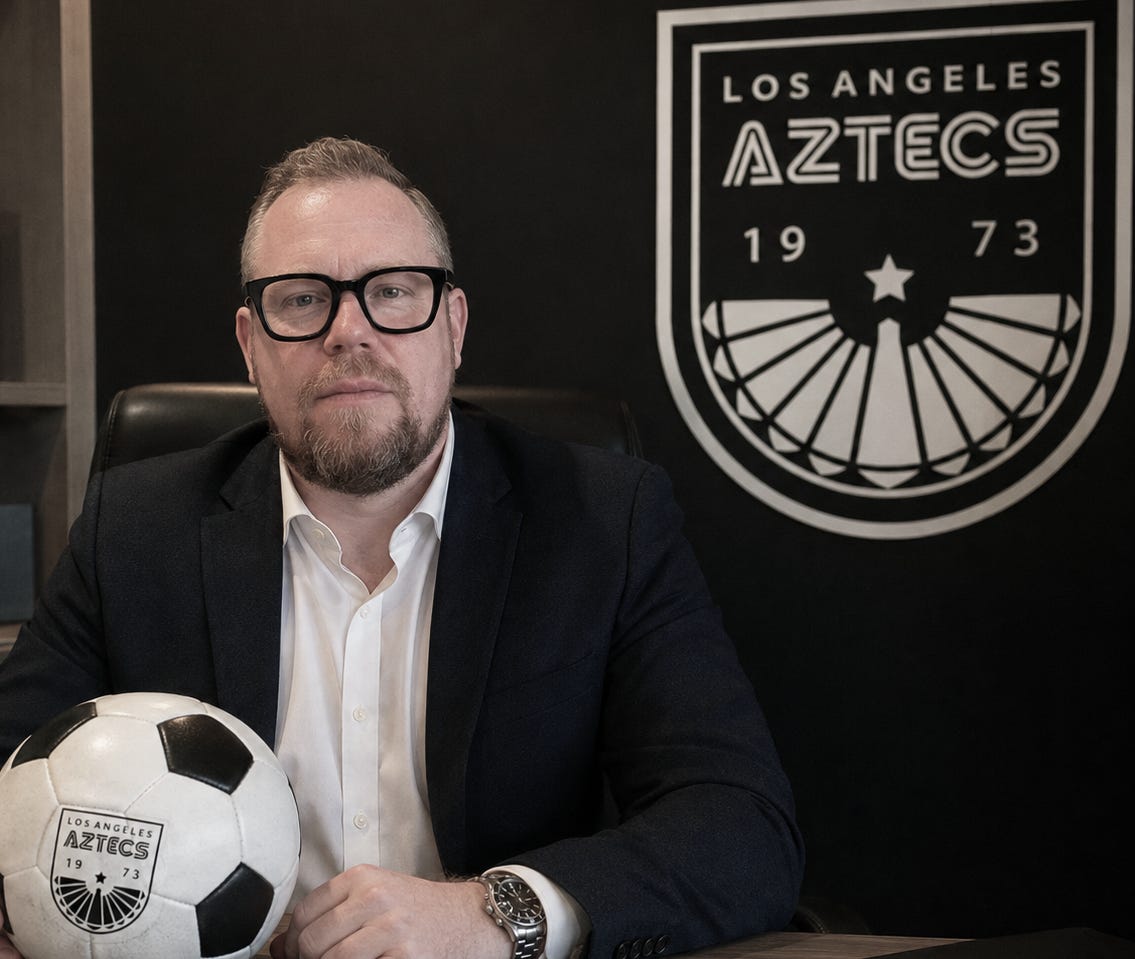
The Los Angeles Aztecs are coming back.
History gives us a head start. It does not give us a football club.
George Best played here. Johan Cruyff played here. Rinus Michels coached here. The old Aztecs lived where Los Angeles, football, music and entertainment collided.
That matters.
But nostalgia does not pay wages, secure land or build a stadium.
So the job is simple to explain and hard to do.
Build the club. Find the home. Create something Los Angeles can keep.
PROJECT SNAPSHOT
Market: Greater Los Angeles
Project: Professional football + sports, entertainment and mixed-use development
Sites assessed: Six
Current leaders: Wilmington/Harbor, Pacoima and Palmdale
Venue brief: 10,000–12,000 seats, expandable towards 20,000–25,000
Land brief: Approximately 20–35+ acres where the right opportunity exists
Model: Football club + civic venue + privately investable district
Current stage: Site selection, municipal dialogue, league evaluation and capital discussions
Next gates: Site control. Written public package. Written league pathway.
Institutional diligence: 33-page development and investor report available to serious parties
WHERE WE ARE
We have stopped asking whether the Aztecs should return.
Now we are deciding where they should live.
Six locations across the Los Angeles market have been assessed. Wilmington/Harbor, Pacoima and Palmdale currently lead the work.
There has also been early dialogue with Los Angeles City Planning around potential locations and what a permanent Aztecs home might require.
That is progress.
It is not an endorsement.
It is not land control.
It is not planning permission.
I would rather tell people where we really are than turn an email into a groundbreaking ceremony.
Football has enough theatre already.
HOME
The Aztecs need one.
A permanent base in the Los Angeles market.
Competitive football. Training. Supporters. Youth development. Community programmes. Commercial partners.
A place where the badge belongs.
That is how clubs grow roots.
Same road. Same stand. Same arguments. Same memories.
Kids remember where they first went with their dad. Players know what shirt they are defending. Local businesses know when the crowd is coming.
That is football.
The league pathway is still being assessed.
We will not choose one because it gives us a good announcement.
It has to work economically.
It has to work geographically.
It has to work for the club.
TOUR
The Aztecs can travel too.
Selected exhibitions. Heritage matches. International opposition. Football festivals. Bigger events when the occasion deserves it.
But TOUR is not the club.
HOME is.
Build a proper home. Fill it. Make it matter.
Then take the Aztecs elsewhere.
HOME gives us roots. TOUR gives us reach.
Simple.
THE STADIUM
Our current brief is for a 10,000–12,000-seat football and entertainment venue, engineered from the start to expand towards 20,000–25,000 if demand earns it.
Not a monument.
Not thousands of empty seats built for somebody’s ego.
A proper football ground.
Steep stands.
Covered seating.
A supporters’ end.
Good sightlines.
Hospitality that earns its keep.
Bars and restaurants that work beyond matchday.
Broadcast infrastructure.
Community space.
Event capability.
And room to grow without knocking half of it down.
The development envelope being tested is approximately $150 million to $200 million.
That is not a committed construction budget.
It is a benchmark to be replaced by site-specific design, independent cost work and, eventually, contractor-backed pricing.
Pretty renderings are cheap. Concrete isn’t.
THE DISTRICT
I do not want a football ground dropped into the middle of a car park and called regeneration.
The land around it matters.
Our working brief therefore looks at approximately 20–35+ acres, where the right opportunity exists.
That could support housing, hotels, restaurants, retail, entertainment, training facilities, commercial space and public areas.
Football brings people.
They come early. Stay late. Eat. Drink. Meet. Spend. Return.
That is where the wider economics begin to work.
Our institutional thesis is that private capital should, wherever possible, be concentrated in assets capable of producing income or appreciating in value rather than disappearing entirely into the stadium bowl.
THE STADIUM CREATES THE DESTINATION.
THE DISTRICT CREATES THE VALUE.
That is the opportunity.
Not property pretending to be football.
Not football pretending economics do not matter.
Both working together.
THE TRANSACTION ARCHITECTURE
Institutional money needs to know where its risk sits.
The proposed structure should therefore keep the major risks separate.
IPCo
Holds and protects the Los Angeles Aztecs brand and intellectual property.
ClubCo
Runs football operations, academy activity, sponsorship, media and club commercial revenues.
StadiumCo
Holds venue operating rights, event income, hospitality, naming rights and stadium-related commercial activity.
DevCo / Site SPV
Holds the site-specific mixed-use development interests — residential, hotel, retail, entertainment and other real-estate assets.
The final structure will depend on league rules, tax, securities law, public-law requirements and the selected site.
But the principle is clear:
Do not force a real-estate investor to underwrite football losses.
Do not force a sports investor to carry property risk they did not ask for.
Each investor should know what they own.
And why.
PUBLIC AND PRIVATE
We are testing an ambitious structure.
The aim is to maximise lawful civic and public participation in the venue and infrastructure while preserving private capital for assets capable of creating long-term value.
That may involve a publicly owned multi-use venue.
It may involve blended public-private financing.
It may involve tax-increment mechanisms, infrastructure support, naming rights, developer contributions, private credit and private equity.
Our institutional work deliberately treats a fully public stadium-capital solution as an opening negotiating position, not an underwriting assumption.
No imaginary percentages.
No capital stack designed backwards to make a spreadsheet balance.
The final stack should be built only after the preferred parcel is known, public-finance capacity is understood and the stadium and district economics have been independently tested.
That is slower.
It is also how serious projects get financed.
CALIFORNIA IS PART OF THE DEAL
Building in California means dealing properly with California.
There is no serious stadium-and-district strategy without an entitlement and environmental strategy.
The selected site must be tested for the most defensible CEQA route available.
That may mean relying on existing environmental work where lawful, tiering from an existing EIR or specific plan, pursuing an addendum or supplemental review, or considering other statutory streamlining where specialist counsel confirms it applies.
What we will not do is promise an artificial 18-month approval because it sounds good in a presentation.
Our existing diligence already identifies the key tests: environmental record, traffic, noise, remediation, entitlement sequence and whether existing planning work can reduce duplication.
The right site is not merely cheap land.
It is land that can be controlled, entitled, funded and defended.
THE LEAGUE PATHWAY
League entry is not a footnote.
It is one of the transaction gates.
Our work is therefore based on a decision tree, not wishful thinking.
Path One — Preferred sanctioned professional route
Test market availability, ownership requirements, territory, stadium standards, operating economics and long-term upside.
Path Two — Alternative sanctioned route
Maintain a credible fallback if the preferred route is too expensive, strategically closed or incompatible with the site.
Path Three — HOME + TOUR bridge
Use selected exhibitions and events to build audience, commercial relationships and operating capability while preserving the permanent HOME strategy.
The rule is simple:
No league value goes into the investor model until the league pathway exists in writing.
Our diligence report already says no investor model should assume MLS NEXT Pro, USL or any other league admission before the relevant requirements are tested.
That is not caution for the sake of caution.
It is how you stop a football decision destroying a real-estate transaction.
COMMUNITY HAS TO BE REAL
If public land, infrastructure or capital participates, the public must receive measurable value.
Not a smiling photograph with children after the press conference.
A framework capable of becoming contractual.
The final Community Benefits Agreement should address:
Youth and schools
Guaranteed annual access, clinics, matchdays and community programming.
Women and girls
Protected access, coaching pathways and playing opportunities.
Jobs and procurement
Negotiated local hiring, apprenticeships and local-business participation.
Affordable access
Community ticket allocations, youth pricing and protected public events.
Housing and district outcomes
Site-specific affordability, public realm, transport and development commitments where residential uses form part of the plan.
Reporting
Measurable targets with regular public reporting.
The report already treats community benefit as a contractual workstream rather than a marketing slogan.
That is how it should stay.
THE SUPPORTERS
I have spent enough time around football to know what happens when supporters become customers.
Prices rise.
Identity gets diluted.
Decisions move farther away from the people who care most.
Then somebody in a boardroom calls it progress.
I want the Aztecs built differently.
Supporters should have a meaningful place in the future of the club.
But fan ownership only matters if there is something worth owning.
A team.
A home.
A community.
A future.
Not a token vote on the colour of the third shirt.
WHAT HAPPENS NEXT
This is where the work gets less glamorous and more valuable.
The next breakthrough is not another badge launch.
It is documentation.
A defined parcel.
A willing landowner.
A credible route to control.
A written public-partnership framework.
A planning pathway.
A league pathway.
Independent cost work.
A site-specific development model.
Legal clearance.
Agreements capable of being financed.
Our institutional report reduces the next major value step to three things:
EXCLUSIVE PARCEL.
WRITTEN PUBLIC PACKAGE.
WRITTEN LEAGUE PATHWAY.
That is where a project starts becoming a transaction.
Until those documents exist, we do not pretend they do.
We work.
WHY THE AZTECS?
Los Angeles does not need another football identity invented in a marketing meeting.
We already have the name.
We already have the story.
What we need is the institution underneath it.
The old Aztecs gave us Best, Cruyff, Michels and one of the brightest, strangest chapters in American football.
We are not trying to recreate 1979.
WE NEED TO EARN 2029.
That means a proper football club with a permanent home.
A stadium at the right scale.
A district capable of creating value.
A capital structure that survives scrutiny.
A community agreement that means something.
A model that can survive bad seasons as well as good ones.
And supporters who still recognise their club when serious money arrives.
That is harder than selling nostalgia.
Good.
Hard things are usually worth building.
WE ARE LOOKING FOR BUILDERS
We are talking to people who can help make this real.
Sports investors.
Real-estate developers.
Municipal partners.
Venue operators.
Football operators.
Public-finance specialists.
Commercial partners.
People who have built complicated things before.
We do not need everybody.
WE NEED THE RIGHT FEW.
A 33-page Institutional Development & Investor Due Diligence Report has been prepared covering the six-site process, stadium strategy, financing architecture, development model, transaction sequencing, league pathway and major risks.
If you are interested in the Los Angeles Aztecs as an investor, developer, civic partner or strategic partner, I would be pleased to hear from you.
Scott Michaels
Los Angeles Aztecs
scott@footballisforthefans.com